On-Page vs Off-Page SEO: A Complete Guide for Indian Businesses
Founders often approach SEO as a single discipline, then get confused when an agency’s proposal only addresses half of it. That confusion usually comes down to a basic but underexplained distinction: on-page and off-page SEO are different disciplines, solving different problems, often requiring different partners entirely. Understanding where one ends and the other begins makes it far easier to hire correctly — and to know what a PR partner can and can’t do for your search visibility.
What On-Page SEO Actually Covers
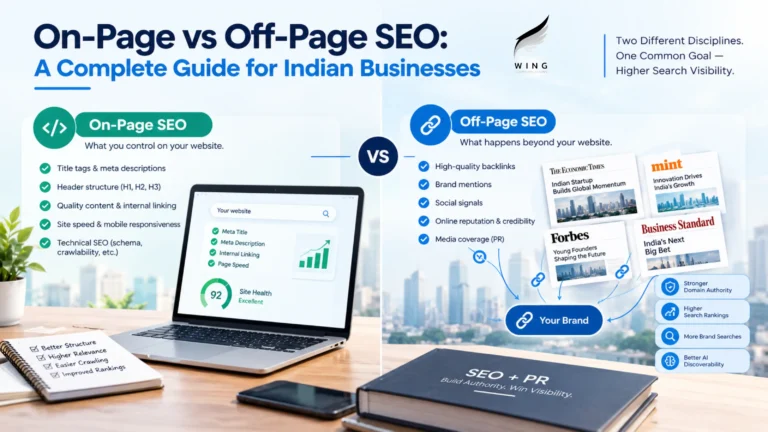
On-page SEO is everything a company controls directly on its own website — page titles, meta descriptions, header structure, internal linking, content quality, site speed, mobile responsiveness, and technical elements like schema markup. It’s fundamentally an engineering and content discipline. A well-executed on-page strategy ensures search engines can crawl a site efficiently and understand what each page is about.
This is foundational work, and it’s a prerequisite — a company with excellent off-page authority but a technically broken website will still struggle to rank, because search engines can’t properly index or evaluate content they can’t crawl well. On-page SEO is typically handled by web development teams, technical SEO specialists, or content teams working closely with developers.
What Off-Page SEO Actually Covers
Off-page SEO is everything that happens outside a company’s own website that signals credibility and authority to search engines — primarily backlinks from other sites, but also brand mentions, social signals, and the broader pattern of how a company is referenced across the web. This is where the discipline overlaps directly with public relations, often more than founders realize.
The strongest off-page signal search engines evaluate is the backlink profile — specifically, how many credible, high-authority domains link back to a company’s site, and in what context. A link earned through genuine editorial coverage in a Tier-1 business publication carries meaningfully more weight than dozens of links from low-authority directories or guest-post farms, which search engines have gotten increasingly effective at discounting.
This is precisely where PR functions as off-page SEO infrastructure, whether or not a company frames it that way. Earned media coverage — a founder byline in a business publication, a feature story referencing the company, a quote in an industry trend piece — produces exactly the kind of high-authority, contextually relevant backlinks that off-page SEO is built to capture. Unlike manufactured link-building tactics, these can’t be purchased or gamed without undermining the credibility that gives them value.
Why This Distinction Matters for Hiring Decisions
Many Indian businesses hire a single “SEO agency” expecting it to handle both disciplines equally well. In practice, on-page technical work and off-page authority-building require genuinely different skill sets — one is closer to web development and content engineering, the other is closer to media relations and narrative strategy. An agency strong in one is rarely equally strong in the other, and generalist packages often underdeliver on the off-page side specifically, because building genuine editorial relationships takes years, not a monthly retainer alone.
For companies with a technically solid website but weak organic visibility, the gap is frequently on the off-page side — insufficient credible backlinks and insufficient third-party validation — rather than anything fixable through further on-page tweaks.
The AI Discoverability Layer
Off-page signals matter for a second, newer reason. AI-driven search tools and answer engines draw heavily on how a brand is discussed across credible external sources when constructing responses about it — a dynamic that closely mirrors how off-page SEO has always worked, just applied to a different kind of output. A company with strong on-page optimization but minimal earned media presence may rank reasonably in traditional search while remaining largely invisible or poorly represented in AI-generated answers, which increasingly draw on the same off-page credibility signals.
A Practical Way to Think About It
On-page SEO ensures a company’s website is technically capable of ranking. Off-page SEO — and specifically, the earned media coverage that produces genuine backlink authority — determines whether search engines, and increasingly AI tools, actually trust that company enough to rank or reference it prominently. Both matter, but they require different expertise, and treating them as a single undifferentiated service usually means one half is being handled by generalists rather than specialists.
Wing Communications operates specifically on the off-page, earned-media side of this equation — building the founder positioning, story placements, and Tier-1 backlink authority that strengthen a company’s broader search and AI discoverability, working alongside whatever technical or on-page SEO function a company already has in place.
FAQs
On-page SEO focuses on optimizing elements within your website, such as content, title tags, internal links, and technical structure. Off-page SEO focuses on external signals, including quality backlinks, brand mentions, and earned media coverage, that help establish credibility and authority.
Both are important. On-page SEO helps search engines crawl, understand, and index your website, while off-page SEO helps build authority and credibility. A balanced strategy combines both approaches.
Key elements include title tags, meta descriptions, heading structure, high-quality content, internal linking, image alt text, mobile responsiveness, page speed, schema markup, and crawlability.
Off-page SEO includes high-quality backlinks, digital PR, editorial media coverage, relevant brand mentions, reputation signals, and other credible references to your business across the web.
Digital PR helps businesses earn media coverage, editorial backlinks, and credible third-party mentions. These can strengthen a website’s backlink profile, support brand authority, and contribute to long-term search visibility.
Contact WingComm today to schedule a free strategy consultation and discover the right PR mix for your business.