blogs

Brand Storytelling: How to Turn Your Company’s Journey Into a Narrative

Brand Storytelling: How to Turn Your Company's Journey Into a Narrative
Every founder believes their company’s origin story is interesting. Most of the time, they’re wrong — not because the underlying facts aren’t real, but because “we started in a garage and now we’re growing fast” is a structure, not a story. Journalists have read thousands of versions of it. The founders who get real narrative traction are the ones who understand the difference between a company history and a story worth telling.

Why Most Founder Narratives Fall Flat

The default version of most company stories follows the same arc: identified a problem, built a solution, faced early struggles, achieved growth. That structure isn’t wrong, but it’s generic enough to apply to almost any company, which is exactly why it rarely gets picked up by credible media. A journalist isn’t looking for confirmation that a founder worked hard and believed in their idea — that’s assumed. They’re looking for something specific: an unusual detail, a genuine tension, a perspective that couldn’t have come from anyone else’s company

What Actually Makes a Story Work

Specificity over sentiment. “We wanted to make healthcare more accessible” says nothing distinctive. “We built this after watching a specific inefficiency cost a hospital real money, and realized the industry’s existing tools were solving the wrong problem” gives a journalist something concrete to write about. The more specific the detail, the more credible and memorable the story becomes — vague inspiration is forgettable; a precise observation is quotable.

Genuine tension, not just triumph. Stories built entirely around smooth success read as marketing, because real company-building rarely is. A founder willing to talk honestly about a wrong turn, a difficult pivot, or a genuine unresolved challenge produces a far more credible and engaging narrative than one that only presents polished outcomes. This doesn’t mean manufacturing conflict — it means not editing out the real difficulty that shaped the company.

A perspective on the industry, not just the company. The strongest founder narratives connect a company’s specific story to a broader observation about their sector — what’s changing, what’s broken, what most people in the industry are missing. This reframes the story from “here’s what we built” to “here’s what we learned about this industry while building it,” which is a fundamentally more interesting angle for a journalist and their readers.

A throughline that holds across every telling. A company’s story shouldn’t shift meaningfully depending on the audience — an investor pitch, a press interview, a customer-facing narrative, and a hiring pitch should all trace back to the same core story, even if emphasis shifts. Founders who tell a different version each time erode the credibility any single version could have built.

Where This Story Should Actually Be Told

A strong narrative loses most of its value if it only lives in an “About Us” page nobody reads. The real work is placing it where it earns third-party credibility — a founder profile in a business publication, a feature story that lets a journalist tell the narrative in their own words, an authored piece where the founder connects their journey to a broader industry insight. Each of these carries a trust signal a company’s own website copy structurally cannot replicate.

Getting the Story Right Before Pitching It

A common mistake is pitching journalists before the narrative itself is sharp. A vague or overly broad story gets a vague or absent response. The more useful sequence is refining the story internally first — identifying the specific angle, the concrete details, the genuine tension — and only then approaching media, rather than hoping a journalist will find the sharp version buried in a generic pitch

The Indian Business Media Context

Indian business publications have genuine appetite for founder stories that connect to larger market or sector narratives — India’s evolving startup ecosystem, shifts in specific industries, the operational realities of building in a market with particular regulatory or infrastructure challenges. A founder story anchored to one of these broader threads tends to land better than an isolated company narrative with no wider relevance.

Building It Deliberately

A company’s story isn’t something to write once and reuse indefinitely. It’s something to refine deliberately — sharpened through genuine specificity, honest tension, and a clear connection to something larger than the company itself — and then placed where it can earn the credibility a founder actually needs.

Wing Communications works with founders to develop this kind of narrative before pursuing media placement, ensuring the story pitched to journalists is sharp enough to earn genuine editorial interest, not just another founder journey piece.

FAQs

A media coverage report summarizes a company’s press mentions, editorial features, interviews, founder quotes, and other media placements. A detailed report also evaluates coverage quality, publication relevance, visibility trends, backlinks, and potential business impact.

Start by reviewing publication quality rather than total article count. Then check whether coverage is earned or paid, assess the relevance of each story, compare founder and brand visibility, examine trends over time, and review backlinks and search performance.

Earned media is coverage gained through independent editorial interest, such as interviews, features, and expert quotes. Paid media includes sponsored articles, advertisements, and other placements purchased by a company. Both can support communications goals, but they should be reported separately.

A high number of placements does not necessarily indicate strong PR performance. Coverage in credible, relevant publications can provide more meaningful opportunities to build trust, establish expertise, and reach important stakeholders than numerous low-value or syndicated mentions.

Contact WingComm today to schedule a free strategy consultation and discover the right PR mix for your business.

Brand Storytelling: How to Turn Your Company’s Journey Into a Narrative Read More »
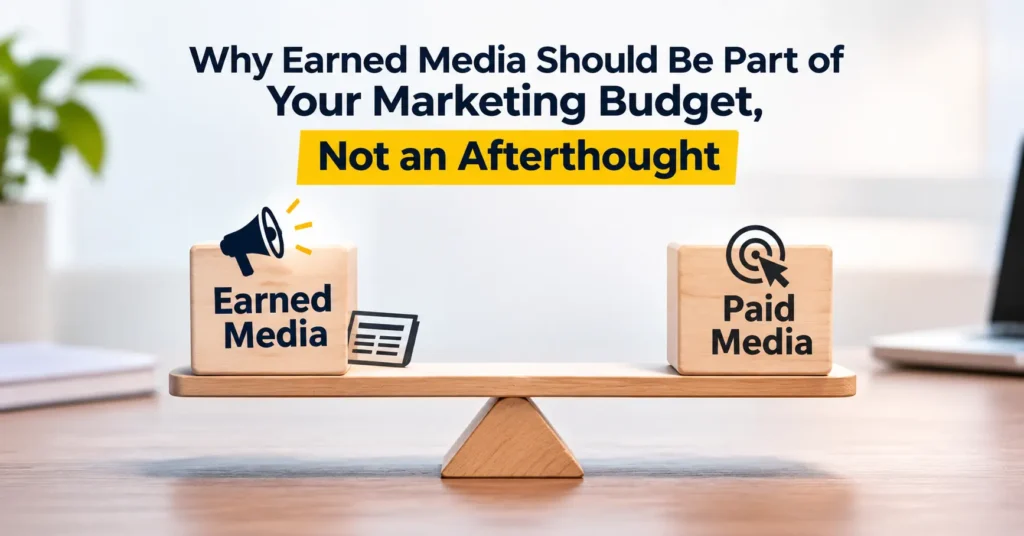
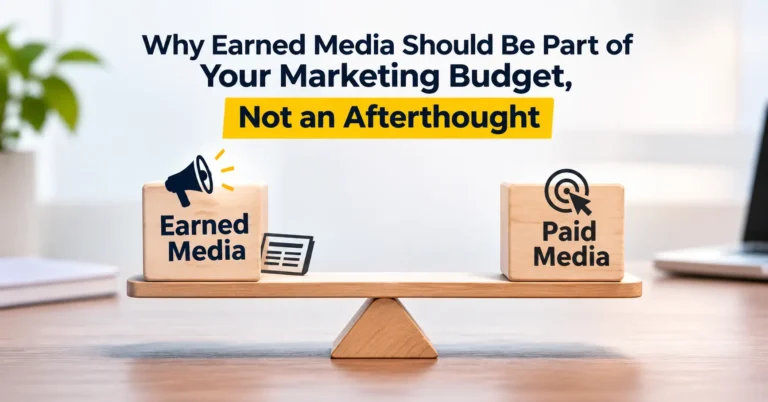
Why Earned Media Should Be Part of Your Marketing Budget, Not an Afterthought

Why Earned Media Should Be Part of Your Marketing Budget, Not an Afterthought

Ask most growing Indian companies to break down their marketing budget, and PR is usually one of two things: a small discretionary line item, or entirely absent until something goes wrong and a crisis response is suddenly needed urgently. Meanwhile, paid social and performance advertising typically absorb the majority of spend, treated as the default engine of growth. That allocation reflects habit more than strategy — and it’s increasingly costing companies more than it needs to.

Why This Allocation Pattern Persists

Paid advertising is easy to justify in a budget conversation. It has a dashboard, a clear cost-per-result, and a familiar logic — spend more, get more reach. PR doesn’t offer that same immediate, attributable feedback loop, which makes it harder to defend in a planning meeting, even when its actual business impact is significant. The result is a systemic underinvestment in earned media, not because it doesn’t work, but because it’s harder to justify in the same spreadsheet logic as a paid campaign.

What Gets Missed When PR Is an Afterthought

Rising paid acquisition costs, with no counterbalance. Costs per click and cost per lead have climbed steadily across most competitive Indian categories. Companies relying almost entirely on paid channels are increasingly paying more for the same results, with no complementary channel building the kind of trust that makes an ad convert better in the first place. Earned coverage does exactly that — a prospective customer or investor who’s already encountered a company through credible press is measurably easier to convert than one encountering the brand cold through an ad.

No credibility reserve when it’s needed most. Companies that treat PR as crisis-only find themselves building a public narrative from scratch under pressure — during a funding round, a leadership transition, or an actual crisis — precisely when there’s no time to build it properly. A modest, consistent PR investment beforehand means there’s already a credible track record to draw on when it matters.

Weaker compounding effects. Paid advertising results largely stop the moment spend stops. Earned media compounds — a strong piece of coverage continues generating backlink value, search visibility, and referenceable credibility long after the initial placement. Budgets that don’t account for this differential tend to systematically undervalue PR relative to its longer-term return.

What a More Balanced Allocation Looks Like

There’s no universal formula, since it depends heavily on stage and goals — a company chasing immediate lead volume genuinely needs more weighted toward performance channels than one building toward a funding round or enterprise sales credibility. But the useful shift for most growing Indian brands is moving PR from a discretionary, ad hoc line item to a planned, consistent monthly allocation — even a modest one — rather than a bucket that only gets funded when there’s budget left over from paid campaigns.

A retainer-based PR engagement, planned quarterly alongside paid spend, allows a company to build earned credibility steadily rather than in the sporadic bursts that come from treating it as an afterthought.

The AI Discoverability Argument for Budgeting This Properly

There’s a newer, forward-looking reason this allocation matters. Paid advertising has no bearing on how a brand is represented in AI-generated search and answer tools — those systems draw on credible, published third-party content, which is precisely what earned media produces and what advertising cannot. A company investing heavily in paid acquisition but nothing in earned coverage may find itself increasingly invisible in a research channel that a growing share of investors, enterprise buyers, and customers now use before making a decision.

A Practical Starting Point

The point isn’t to abandon paid social or performance advertising — both remain legitimate, necessary tools for many growth goals. The point is recognizing that a marketing budget with no planned allocation for earned media is building growth on a single, increasingly expensive channel, with no credibility infrastructure supporting it.

Wing Communications works with growing Indian brands to build PR into the marketing budget as planned, ongoing infrastructure — not a crisis response or a leftover line item — so earned credibility compounds alongside, rather than after, paid growth efforts.

FAQs

A media coverage report summarizes a company’s press mentions, editorial features, interviews, founder quotes, and other media placements. A detailed report also evaluates coverage quality, publication relevance, visibility trends, backlinks, and potential business impact.

Start by reviewing publication quality rather than total article count. Then check whether coverage is earned or paid, assess the relevance of each story, compare founder and brand visibility, examine trends over time, and review backlinks and search performance.

Earned media is coverage gained through independent editorial interest, such as interviews, features, and expert quotes. Paid media includes sponsored articles, advertisements, and other placements purchased by a company. Both can support communications goals, but they should be reported separately.

A high number of placements does not necessarily indicate strong PR performance. Coverage in credible, relevant publications can provide more meaningful opportunities to build trust, establish expertise, and reach important stakeholders than numerous low-value or syndicated mentions.

Contact WingComm today to schedule a free strategy consultation and discover the right PR mix for your business.

Why Earned Media Should Be Part of Your Marketing Budget, Not an Afterthought Read More »

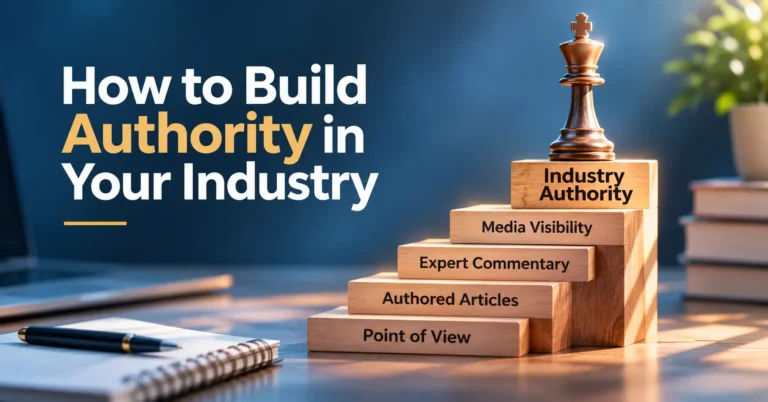
Thought Leadership Content: How to Build Authority in Your Industry

Thought Leadership Content: How to Build Authority in Your Industry

The term “thought leadership” has been diluted by overuse — applied to everything from a mildly insightful LinkedIn post to a genuinely original industry perspective. That dilution matters, because it’s made founders skeptical of the term while still needing exactly what it’s supposed to describe: genuine authority that makes an industry pay attention when a founder speaks. Building that authority requires more discipline than most content calendars account for.

What Thought Leadership Actually Requires

Real thought leadership starts with a specific, defensible point of view — not a restatement of consensus wisdom, and not generic optimism about an industry’s future. A founder saying “AI will transform healthcare” says nothing distinctive. A founder saying “most healthcare AI tools fail not because of the technology but because they’re built without understanding clinical workflow” says something worth engaging with, agreeing with, or arguing against — which is precisely the reaction genuine thought leadership is supposed to produce.

This distinction is where most content strategies go wrong. They optimize for volume and consistency before they’ve established substance, producing a steady stream of content that’s professionally written but says very little that couldn’t have come from any other founder in the category.

Building the Foundation Before the Content

Identify what you actually know that others don’t. Every founder has some genuine, hard-won insight from building their company — a pattern they’ve observed, a mistake they’ve made and corrected, a counterintuitive lesson about their market. This is usually more specific and more valuable than founders initially think, because it’s easy to underestimate knowledge that’s become second nature.

Pick a narrow enough lane. Thought leadership that tries to cover an entire industry broadly ends up sounding generic. The founders who build real authority usually own a specific, narrower angle within their space — a particular problem, a specific stakeholder’s pain point, a specific inefficiency — and go deep there consistently, rather than commenting broadly on everything happening in their sector.

Be willing to take a position that isn’t universally comfortable. Genuinely differentiated thought leadership sometimes means disagreeing publicly with a popular industry narrative, or pointing out something uncomfortable about how a sector operates. Founders who only ever say agreeable, safe things rarely get remembered as authorities — they get politely ignored.

Where This Content Should Actually Live

Authored articles in credible publications, not just owned channels. A byline in a relevant trade or business publication carries a credibility that a company blog post structurally cannot — because a third-party editor decided it was worth publishing, which readers register even if unconsciously. This is where PR and content strategy intersect directly: securing these placements is a media relations skill, not just a writing exercise.

Speaking opportunities matched to the specific point of view, not any available panel. A founder with a sharp perspective on a niche problem is better served speaking at a smaller, focused industry forum than a large generic startup conference where the message gets diluted among unrelated topics.

Consistent commentary as a source, not just a contributor. Being available and quotable when journalists are writing about relevant industry developments — not just when a company has its own news — builds the pattern of being treated as a genuine industry reference, which compounds far more than isolated bylines.

Where This Compounds

Thought leadership content that’s genuinely substantive doesn’t just build a founder’s reputation among human readers. It also becomes part of the credible published record that AI tools draw on when constructing answers about an industry or a specific problem — meaning a founder with a consistent, well-documented point of view is more likely to surface as a reference point in AI-generated research, a form of durable visibility that compounds well beyond any single article’s original readership.

Building It Properly

Thought leadership isn’t a content format — it’s the output of a founder having something genuinely worth saying, said consistently, in places with enough editorial credibility to matter. Skipping the substance and going straight to content production is why most thought leadership efforts feel forgettable.

Wing Communications works with founders to identify that defensible point of view first, then builds the sustained media placements — authored articles, quote positioning, and speaking opportunities — that turn a genuine perspective into recognized industry authority

FAQs

A media coverage report summarizes a company’s press mentions, editorial features, interviews, founder quotes, and other media placements. A detailed report also evaluates coverage quality, publication relevance, visibility trends, backlinks, and potential business impact.

Start by reviewing publication quality rather than total article count. Then check whether coverage is earned or paid, assess the relevance of each story, compare founder and brand visibility, examine trends over time, and review backlinks and search performance.

Earned media is coverage gained through independent editorial interest, such as interviews, features, and expert quotes. Paid media includes sponsored articles, advertisements, and other placements purchased by a company. Both can support communications goals, but they should be reported separately.

A high number of placements does not necessarily indicate strong PR performance. Coverage in credible, relevant publications can provide more meaningful opportunities to build trust, establish expertise, and reach important stakeholders than numerous low-value or syndicated mentions.

Contact WingComm today to schedule a free strategy consultation and discover the right PR mix for your business.

Thought Leadership Content: How to Build Authority in Your Industry Read More »

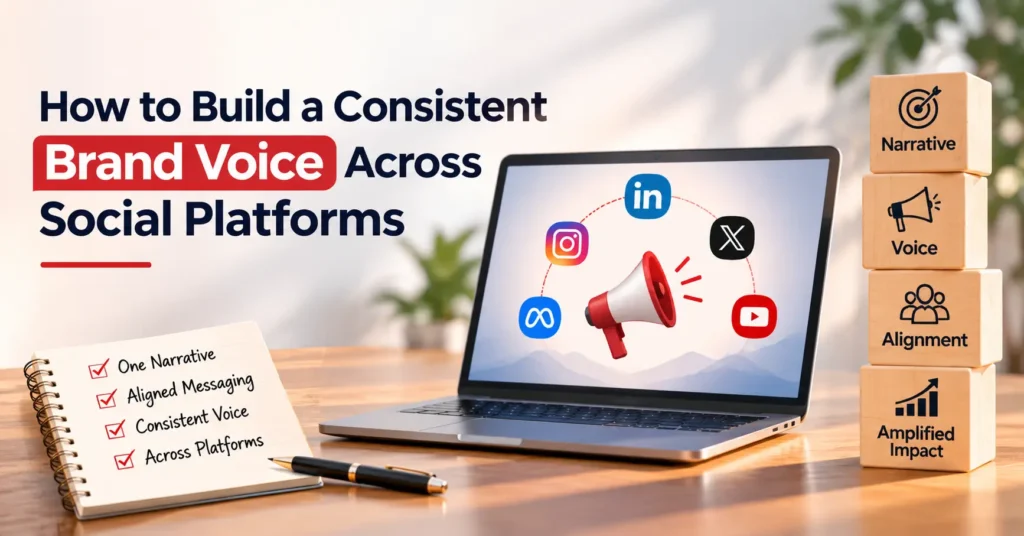
How to Build a Consistent Brand Voice Across Social Platforms

How to Build a Consistent Brand Voice Across Social Platforms

Most conversations about brand voice start with tone — casual or formal, playful or serious. That’s the surface layer. The deeper problem most companies actually have isn’t tone inconsistency; it’s narrative inconsistency — a brand that sounds fine on any single platform but tells a slightly different story about itself depending on where you encounter it. That’s a communications problem before it’s a social media problem, and it’s usually rooted in how a company’s core messaging was built in the first place.

Voice Follows Narrative, Not the Other Way Around

A common mistake is treating brand voice as a style guide exercise — approved adjectives, sentence length preferences, an emoji policy. Useful, but downstream of a bigger question: what is this company’s actual story, and does everyone writing on its behalf understand it the same way? A precise tone applied to an unclear or shifting narrative just produces consistently confusing content.

The companies with genuinely coherent brand voice usually have a clear point of origin — a founder narrative, a specific market position, a defined problem the company exists to solve — that every piece of content, regardless of platform or format, traces back to. Voice consistency is really narrative discipline wearing a stylistic coat.

Where Indian Brands Commonly Fragment

Different teams, no shared source material. Social media, PR, and content marketing are frequently run by separate people or separate vendors with limited coordination. A founder’s carefully positioned narrative from a media interview doesn’t make it into the social team’s content brief, so the LinkedIn post ends up telling a slightly different, less precise version of the same story.

Reactive posting without a reference point. Teams under pressure to post consistently often generate content in the moment, disconnected from the company’s actual established positioning — resulting in technically on-brand tone but strategically off-message content.

Founder voice versus company voice, unreconciled. Many Indian companies run both a founder’s personal presence and a company account, often with different people managing each, and no clear alignment on which narrative points belong where. Audiences following both notice the disconnect, even if they can’t articulate exactly what feels off.

Building It Properly

Start from earned narrative, not a style guide. The most reliable source for a consistent brand voice is the story that’s already been tested and validated externally — through media coverage, founder interviews, and press positioning. If a founder’s narrative has already been refined through genuine media conversations, that refined version should anchor everything else, rather than each platform inventing its own framing independently.

Create one shared reference document, not separate briefs per platform. A single source — core positioning, key messages, founder’s established point of view, language to avoid — should inform social content, PR pitches, and website copy alike. Platform-specific formatting can vary; the underlying narrative shouldn’t.

Treat founder and brand voice as connected, not identical. A founder’s personal voice can be more opinionated and informal than a corporate account’s, but the substance — the positioning, the point of view on the industry — should align. Divergence in tone is fine. Divergence in narrative is a problem.

Audit before adding more content. Before producing more social content, it’s worth reviewing what’s already out there — across the company page, the founder’s profile, recent press coverage — and checking whether it tells one coherent story or several competing ones. Most brands are surprised by how much drift has accumulated without anyone noticing in real time.

Why This Matters Beyond Social Media

A consistent narrative doesn’t just make a brand look more polished — it directly affects how the brand is understood by search engines and AI tools evaluating consistency across sources. A company that’s described one way in press coverage, another way on its own social channels, and a third way in its website copy makes it harder for these systems to form a clear, accurate picture — which increasingly shapes how a brand is represented in AI-generated answers about it.

Google’s Organization structured data guidelines provide additional context on how clearly identifying an organisation helps search engines understand its identity.

A Practical Starting Point

Brand voice consistency isn’t primarily a content calendar problem. It’s a narrative alignment problem that shows up on content calendars. Getting the underlying story right — and making sure PR, founder positioning, and social content are all drawing from the same source — solves the tone inconsistency almost as a byproduct.

Research from the Nielsen Norman Group on tone of voice also highlights how communication tone influences perceptions of brand trustworthiness and desirability.

Wing Communications approaches this by anchoring a client’s social and public-facing voice in the same core narrative built through earned media and founder positioning work — so a brand sounds like one consistent story, whether encountered in a press feature, a founder’s post, or a company update.

FAQs

A media coverage report summarizes a company’s press mentions, editorial features, interviews, founder quotes, and other media placements. A detailed report also evaluates coverage quality, publication relevance, visibility trends, backlinks, and potential business impact.

Start by reviewing publication quality rather than total article count. Then check whether coverage is earned or paid, assess the relevance of each story, compare founder and brand visibility, examine trends over time, and review backlinks and search performance.

Earned media is coverage gained through independent editorial interest, such as interviews, features, and expert quotes. Paid media includes sponsored articles, advertisements, and other placements purchased by a company. Both can support communications goals, but they should be reported separately.

A high number of placements does not necessarily indicate strong PR performance. Coverage in credible, relevant publications can provide more meaningful opportunities to build trust, establish expertise, and reach important stakeholders than numerous low-value or syndicated mentions.

Contact WingComm today to schedule a free strategy consultation and discover the right PR mix for your business.

How to Build a Consistent Brand Voice Across Social Platforms Read More »

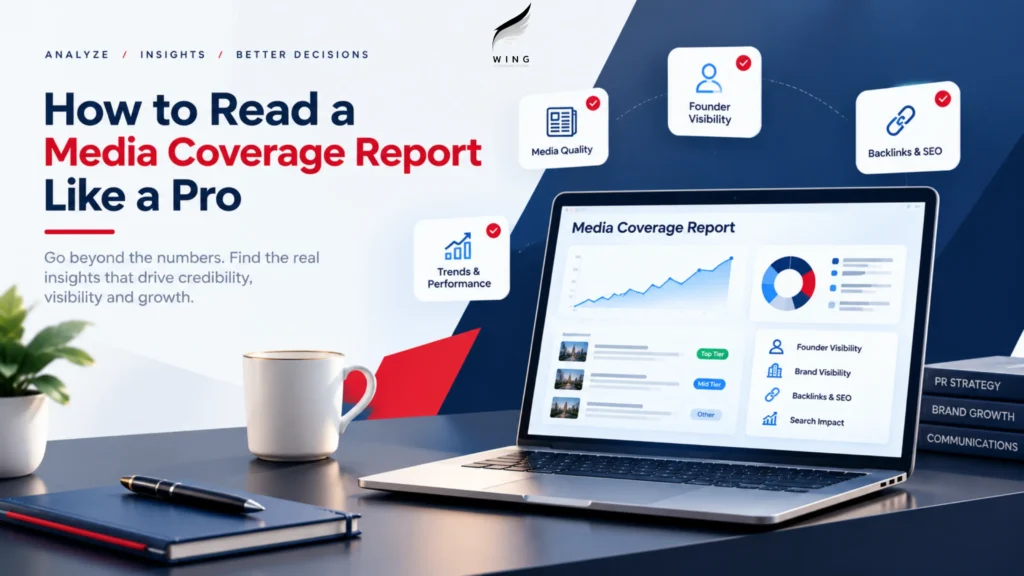
How to read a media coverage report using analytics dashboards to evaluate media quality, brand visibility, backlinks, and PR performance.

How to Read a Media Coverage Report Like a Pro

How to Read a Media Coverage Report Like a Pro

How to read a media coverage report using analytics dashboards to evaluate media quality, brand visibility, backlinks, and PR performance.

Most founders receive a monthly PR report, skim the article count, and move on. That’s a missed exercise. A well-built coverage report holds more useful information than a headline number — about which stories are actually working, where the gaps are, and whether the PR investment is compounding or plateauing. Reading it properly takes a few extra minutes and a slightly different lens than most founders bring to it.

Start With Tier, Not Volume

The first instinct is usually to look at total placements. Resist that. The more useful first question is: what tier were these placements? A report showing twelve pieces of coverage means very little without knowing how many were genuine editorial features in credible business publications versus wire syndication pickups, which are a different thing entirely — distribution, not independent editorial judgment. A report that blends both categories into a single “coverage” number without distinguishing them is worth questioning.

Check Whether Coverage Is Earned or Placed

Related, but distinct: confirm what’s earned editorial versus what’s paid or sponsored content, if the report includes both. These serve different purposes and shouldn’t be presented as equivalent. A credible agency report should make this distinction clear on its own — if it doesn’t, ask directly. Learn more about media relations and earned press coverage.

Look at the Angle, Not Just the Outlet

A placement in a well-known publication still needs scrutiny on what the story actually says. Was the company or founder positioned as a genuine source of insight, quoted meaningfully within a larger story? Or was the mention a passing reference, technically counted as coverage but contributing little to actual positioning? Outlet prestige alone doesn’t tell the full story — the substance of the piece does.

Track Founder Visibility Separately From Brand Visibility

These are related but distinct workstreams, and a good report separates them. Founder-focused coverage — bylines, quotes, panel mentions — builds a different kind of asset than brand-focused feature stories. A report that only tracks brand mentions may be missing whether founder positioning, often the more durable asset, is actually progressing. Explore leadership PR and founder brand building for more information.

Watch the Trend, Not the Single Month

A single month’s numbers are close to meaningless in isolation. PR compounds — the value of month six’s coverage builds on the credibility established in months one through five. A useful report, reviewed properly, gets compared against the prior quarter, not just read in isolation. A dip in one month against a strong prior quarter is a different story than a dip against a consistently weak trend.

Ask About What Didn't Land

A transparent report should be honest about pitches that went out but didn’t result in coverage — not just what succeeded. This is a genuine signal of effort and story quality, even when it doesn’t show up as a placement. An agency that only reports wins, with no visibility into outreach volume or what was pitched and passed on, makes it hard to judge whether the strategy is sound or just intermittently lucky. Learn more about what a PR agency does and the importance of transparent PR reporting.

Check for Backlink and Search Signal, Not Just Media Mentions

A more sophisticated report increasingly includes what the coverage did beyond the article itself — whether it produced a credible backlink, whether it correlates with branded search increases, whether it’s likely to be picked up by AI tools drawing on published, credible content when someone asks about the company or its category. These downstream signals are becoming as relevant as the placement itself.

Businesses can use Google Search Console to review search impressions and clicks, and follow Google’s SEO Starter Guide to understand search visibility fundam

What a Strong Report Actually Looks Like

The most useful coverage reports don’t just list links. They tier the coverage, separate founder and brand visibility, show trend over time rather than isolated snapshots, disclose what didn’t work alongside what did, and connect coverage to its downstream effects on search and discoverability. A founder who knows to ask for this level of detail gets far more strategic value out of the same reporting relationship than one who just checks the article count each month.

Wing Communications structures its monthly reporting around exactly this level of detail — tiered coverage, founder and brand visibility tracked separately, and downstream backlink and discoverability signal — because a report a founder can actually read and act on is worth more than one that just counts links. Explore Wing Communications and its SEO services to learn more about connecting media coverage with search visibility and long-term brand authority.

FAQs

A media coverage report summarizes a company’s press mentions, editorial features, interviews, founder quotes, and other media placements. A detailed report also evaluates coverage quality, publication relevance, visibility trends, backlinks, and potential business impact.

Start by reviewing publication quality rather than total article count. Then check whether coverage is earned or paid, assess the relevance of each story, compare founder and brand visibility, examine trends over time, and review backlinks and search performance.

Earned media is coverage gained through independent editorial interest, such as interviews, features, and expert quotes. Paid media includes sponsored articles, advertisements, and other placements purchased by a company. Both can support communications goals, but they should be reported separately.

A high number of placements does not necessarily indicate strong PR performance. Coverage in credible, relevant publications can provide more meaningful opportunities to build trust, establish expertise, and reach important stakeholders than numerous low-value or syndicated mentions.

Contact WingComm today to schedule a free strategy consultation and discover the right PR mix for your business.

How to Read a Media Coverage Report Like a Pro Read More »

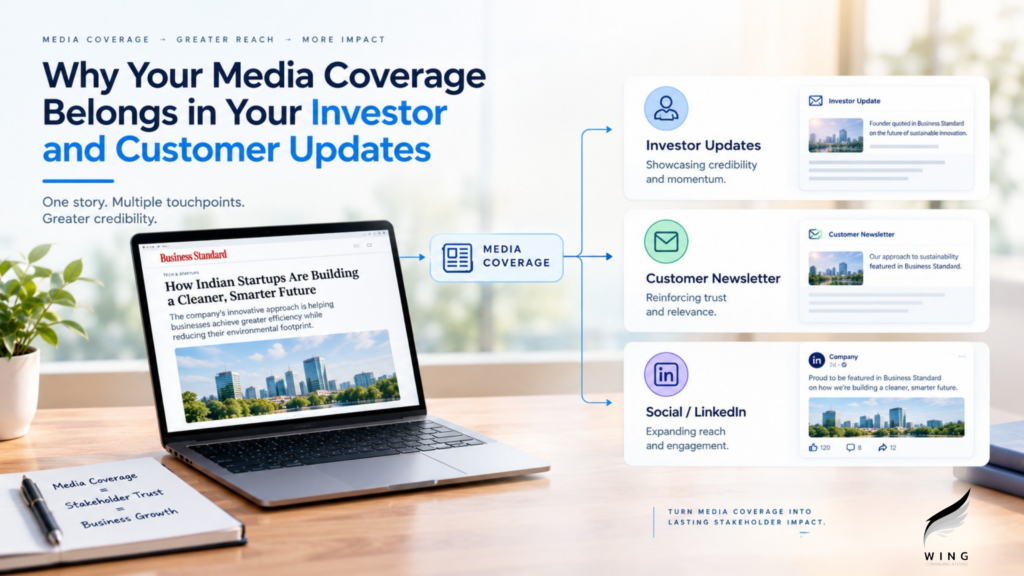
How companies can use media coverage in investor updates and customer newsletters to build credibility and stakeholder trust.

Why Your Media Coverage Belongs in Your Investor and Customer Updates

Why Your Media Coverage Belongs in Your Investor and Customer Updates

How companies can use media coverage in investor updates and customer newsletters to build credibility and stakeholder trust.

Most companies treat media coverage as a one-time asset — a link shared on LinkedIn, maybe added to a website’s “in the news” page, and then forgotten. Meanwhile, the same company sends monthly investor updates and customer newsletters that rarely reference the coverage at all. That’s a missed opportunity. Earned media doesn’t just build external credibility — it’s some of the strongest content a company already has sitting unused in its own stakeholder communications.

Why This Gap Exists

PR and email communications are usually run by different people, sometimes different teams entirely, with no real handoff between them. A founder secures a feature in a business publication, the PR team reports it as a placement win, and the story ends there. Nobody loops it into the investor update going out three weeks later, or the customer newsletter that could use exactly this kind of third-party validation. The coverage exists, but it never reaches the audiences who’d find it most persuasive.

Why Media Coverage Belongs in Investor Updates Specifically

Investors — current and prospective — read updates looking for signals of momentum and credibility, not just metrics. A line in a monthly update noting that the founder was quoted in Mint on an industry trend, or that the company was featured in a Business Standard piece on sector consolidation, does something a growth chart alone can’t: it shows the company is being recognized by an independent, credible third party, not just reporting its own numbers.

This matters more ahead of a funding round. Investors doing diligence often search a company’s name before a first meeting. A founder who’s proactively surfaced relevant coverage in prior updates has already shaped part of that research — rather than leaving an investor to stumble on it cold, or not find it at all.

Why It Belongs in Customer Communications Too

For B2B companies particularly, a customer newsletter that references credible third-party coverage — a founder’s byline on an industry challenge, a feature explaining the company’s approach to a known problem — reinforces trust in a way product updates alone don’t. Customers renewing a contract or considering an upsell respond differently to “our founder was recently featured discussing this exact challenge” than to another feature announcement.

This doesn’t mean turning every email into a press digest. It means treating genuinely relevant coverage as legitimate content, worth a line or a short section, rather than something that only lives on a website’s press page. Effective email newsletter writing can help keep these updates relevant and useful to their intended audience.

How to Actually Do This Well

Be selective, not exhaustive. Not every piece of coverage belongs in every update. A wire syndication pickup with limited editorial substance isn’t worth including. A genuine feature, a founder byline, or a credible quote placement usually is. Curating rather than listing everything keeps the update credible instead of cluttered.

Frame it for the reader, not the company. Rather than “we were featured in X,” a stronger frame connects the coverage to something the reader cares about — “here’s how [publication] covered the shift we’ve been building toward,” positioning the coverage as insight the reader benefits from, not just a company win being announced.

Keep the cadence realistic. If coverage is sparse in a given month, it’s fine to skip this section entirely rather than stretching a minor mention to fill space. Forced inclusion undermines the credibility this is meant to build.

Link back to the original source. Beyond the immediate communication value, this reinforces the backlink and referral traffic value of the original coverage — a secondary benefit that compounds when stakeholders click through to the actual publication.

The Broader Point

This is really about recognizing that earned media has a longer useful life than most companies give it credit for. A single piece of coverage can serve a press page, a sales conversation, a LinkedIn post, an investor update, and a customer newsletter — but only if someone is deliberately connecting PR output to the rest of a company’s stakeholder communications, rather than treating PR as a siloed function that stops mattering once the article is published.

Companies that do this well tend to get more return from the same volume of coverage than companies generating just as much media attention but leaving it stranded on a press page nobody revisits.

Wing Communications works with founders to think about earned coverage this way — not as an isolated deliverable, but as reusable credibility infrastructure that should show up everywhere a company is already talking to the people who matter most, from investor updates to customer communications. Explore Wing Communications’ thought leadership services and media relations services to learn more about building visibility and credibility through strategic communications.

FAQs

Media coverage provides independent third-party validation of a company’s progress, leadership, and industry relevance. Including credible press mentions in investor updates helps communicate momentum and strengthen investor confidence.

Coverage in reputable publications can demonstrate that a company and its leadership are gaining industry recognition. It can also give investors additional context about the business, market position, and expertise beyond internal performance reports.

Sharing relevant media coverage reinforces credibility and helps customers understand the company’s expertise, industry contributions, and approach to solving business challenges. It adds third-party validation alongside product news and company updates.

Companies should prioritize credible editorial features, founder interviews, expert commentary, and thought leadership articles in relevant publications. Coverage should be useful to the intended audience rather than included simply to increase the number of press mentions.

Contact WingComm today to schedule a free strategy consultation and discover the right PR mix for your business.

Why Your Media Coverage Belongs in Your Investor and Customer Updates Read More »

Beyond ROAS earned media impact, featuring digital PR analytics, backlink growth, brand visibility, and AI discoverability.

Beyond ROAS: Why Earned Media Impact Is Harder to Measure — and Still Worth Tracking

Beyond ROAS: Why Earned Media Impact Is Harder to Measure — and Still Worth Tracking

Beyond ROAS earned media impact, featuring digital PR analytics, backlink growth, brand visibility, and AI discoverability.

Ask a performance marketer how a campaign is doing, and they’ll have an answer within minutes — CAC, ROAS, CTR, cost per lead, all sitting in a dashboard, updated in real time. Ask a founder how their PR is doing, and the honest answer is usually messier. That gap in measurability is real, but it’s often misread as PR being less valuable, rather than what it actually is: a different kind of value, measured differently, over a longer horizon.

Founders who apply performance marketing logic directly to PR — expecting a clean, immediate ROI number — end up either underinvesting in something that works, or over-relying on vanity metrics that don’t mean much.

Why the Measurement Frameworks Don't Transfer

Performance marketing metrics work because the entire discipline is built around a closed loop — an ad is shown, a click happens, a conversion is tracked, and a cost is attributed directly to that outcome. PR doesn’t operate in a closed loop. A founder’s byline in a business publication might influence an investor’s decision three months later, shape how a prospective enterprise client perceives the company before a sales call even happens, or shift how an AI tool describes the brand to someone who never saw the original article. None of that shows up in a last-click attribution model, but all of it is real business impact.

This doesn’t mean PR is unmeasurable. It means it needs its own framework, not a borrowed one.

For more context, explore what a PR agency does and how strategic communications support long-term brand credibility.

What's Actually Worth Tracking

Media quality, not just media volume. A monthly count of “articles published” is a weak metric on its own — it doesn’t distinguish between a wire syndication pickup and a genuine editorial feature in a Tier-1 publication. A more useful measure tiers coverage by publication credibility and whether it’s earned editorial or syndicated distribution, so a company knows whether its numbers reflect substantive placements or inflated pickup counts.

Backlink authority generated. This is one of the more concrete, trackable outputs of PR work. Earned coverage in credible publications produces backlinks from high-authority domains, which is measurable through standard SEO tools and correlates over time with a company’s own domain authority and organic search performance. This gives PR a genuine, quantifiable connection to a metric marketing teams already track. For additional guidance, refer to Google’s SEO Starter Guide.

Branded search lift. When a company appears in credible coverage, it typically sees an increase in people searching the company or founder’s name directly afterward. This is trackable through Google Search Console data and, tracked over a sustained period, is one of the clearer signals that coverage is actually reaching and registering with an audience — not just accumulating in a report. Google’s branded queries filter can also help distinguish branded from non-branded search activity.

Share of voice versus competitors. Rather than measuring PR in isolation, comparing a company’s media presence against direct competitors — frequency, publication tier, founder visibility — gives a relative benchmark that’s more meaningful than an absolute number. Being covered five times a quarter looks different if competitors are averaging two versus averaging fifteen.

AI representation. A newer, less standardized but increasingly relevant check: periodically querying AI tools like ChatGPT and Perplexity about a company or its category and reviewing how — or whether — the brand is represented. This won’t produce a clean quantitative metric yet, but tracked over time, it reveals whether earned coverage is translating into visibility in a channel a growing number of buyers and investors now use for research. Businesses can also review Google’s guidance on AI features and your website.

Qualitative signal from stakeholders. Sometimes the clearest evidence of PR impact is direct — an investor mentioning they’d read a founder’s byline before a meeting, a prospective client referencing a feature article during a sales conversation, a candidate citing a piece of coverage as a reason they applied. These signals don’t fit neatly into a dashboard, but dismissing them because they’re not quantitative undervalues genuinely important evidence.

What This Means for Evaluating PR Spend

The right question isn’t “what’s my ROAS on PR” — that framework doesn’t fit. The better question is whether coverage quality, backlink authority, branded search, and competitive share of voice are moving in the right direction over a sustained period, alongside qualitative signal from the stakeholders PR is actually meant to influence — investors, enterprise buyers, talent, and increasingly, AI systems doing the research on a company’s behalf.

Founders evaluating a PR partner should ask for reporting against these dimensions specifically, rather than accepting a simple article count as the full measure of value. It’s a more honest, and ultimately more useful, way to judge whether the work is compounding. This is also an important consideration when choosing the right PR agency.

Wing Communications reports against exactly this kind of framework — coverage tier, backlink authority, and sustained visibility trends — treating earned media as an investment measured over quarters, not a campaign measured in clicks. Learn more about Wing Communications and its approach to combining PR with SEO for long-term brand visibility.


FAQs

Earned media impact refers to the value a brand gains through editorial coverage, media mentions, expert commentary, and other publicity it does not directly pay to publish. It can improve brand credibility, visibility, search performance, and stakeholder trust.

Performance marketing uses direct tracking to connect advertising spend with clicks and conversions. PR often influences brand perception, investor confidence, customer trust, and future purchasing decisions over a longer period, making its impact harder to attribute to a single campaign.

Yes. PR ROI can be evaluated using a combination of measurable indicators and qualitative feedback, including media quality, referral traffic, backlinks, branded search growth, share of voice, and stakeholder responses.

Earned media can increase brand awareness, generate referral traffic, and create opportunities for relevant backlinks. These outcomes can support organic search visibility over time, although media coverage or backlinks do not guarantee higher rankings.

Contact WingComm today to schedule a free strategy consultation and discover the right PR mix for your business.

Beyond ROAS: Why Earned Media Impact Is Harder to Measure — and Still Worth Tracking Read More »

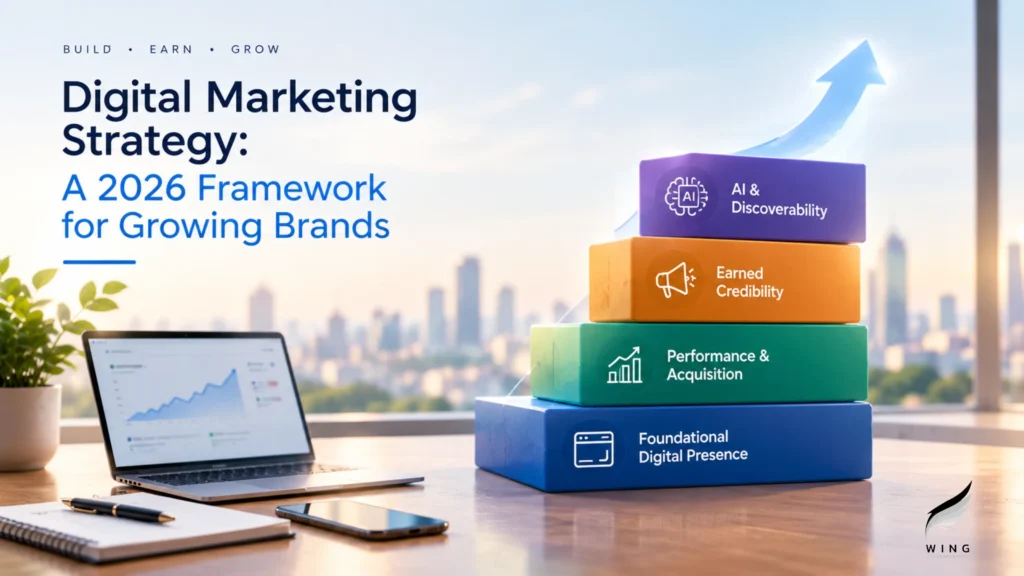
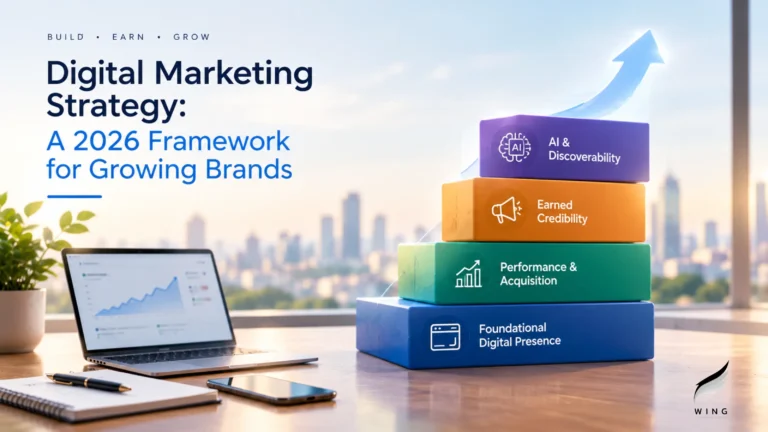
2026 digital marketing strategy framework showing digital presence, performance marketing, earned credibility, and AI discoverability.

Digital Marketing Strategy: A 2026 Framework for Growing Brands

Digital Marketing Strategy: A 2026 Framework for Growing Brands

2026 digital marketing strategy framework showing digital presence, performance marketing, earned credibility, and AI discoverability.

Every year brings a fresh wave of “the new rules of digital marketing” content, and most of it is noise dressed as insight. But a few genuine shifts are shaping how brands grow right now. One of the most significant is the growing importance of credibility and earned trust within what used to be a predominantly performance-driven discipline.

A modern digital marketing strategy needs to account for this shift. Beyond paid acquisition and organic traffic, brands must build credibility, strengthen their online presence, and improve how they are discovered across search engines and AI-powered platforms.

Why the Old Digital Marketing Framework Is Breaking Down

For years, digital marketing strategy meant a predictable combination of paid acquisition, SEO content, social media, email marketing, and conversion optimization. These channels remain important, but relying on them alone can limit growth.

Paid acquisition can become expensive in competitive markets. Content saturation makes it harder for a new article to stand out, while buyers increasingly use AI-powered tools alongside traditional search to research companies, products, and services.

According to Google’s guidance on AI features in Search, foundational SEO practices remain relevant to AI-powered search experiences. This reinforces the importance of technically accessible websites, helpful content, and clear information.

For brands, the opportunity is to treat credibility-building as a core part of digital marketing rather than an afterthought.

The Four Layers of a Digital Marketing Strategy for 2026

1. Foundational Digital Presence

The foundation includes a technically sound website, clear page structure, useful content, on-page SEO, and effective conversion paths.

Businesses should ensure that their websites are easy to navigate, mobile-friendly, accessible to search engines, and aligned with what their audiences are searching for.

Google’s SEO Starter Guide provides practical guidance on making website content easier for search engines to discover and understand.

For a deeper understanding of website optimization, businesses can also explore our guide to choosing the right PR and digital marketing agency in Hyderabad.

A strong digital presence helps a brand get discovered. However, visibility alone does not automatically establish trust.

2. Performance Marketing and Customer Acquisition

Paid search, paid social, and performance-focused content remain valuable for generating measurable actions such as enquiries, registrations, and sales.

These channels help businesses reach defined audiences, test messaging, and understand which campaigns contribute to conversions. Their effectiveness, however, depends on more than ad targeting and creative quality.

A potential customer may discover a company through an advertisement and then search for its reputation, leadership team, customer feedback, or media coverage before making a decision.

This is where brand credibility supports customer acquisition. When a business has a clear message and a credible external presence, its paid campaigns have more context to work with.

The objective is not to replace performance marketing but to strengthen it with a consistent brand narrative and trustworthy third-party references.

3. Earned Credibility Through Digital PR

Earned credibility is one of the most underappreciated layers of many digital marketing strategies.

Media coverage, founder thought leadership, expert commentary, and independent third-party references help audiences evaluate a brand beyond its own advertising and website claims.

A founder quoted in a relevant business publication or a company featured in an industry story gains an opportunity to demonstrate expertise in a credible editorial context.

Earned media can also support SEO when coverage generates relevant editorial backlinks. These links can help search engines discover pages and understand how websites connect to one another. Their value depends on relevance, context, and the quality of the linking source.

For more on this relationship, read our guide to what a PR agency does and how it builds brand credibility.

Businesses should prioritize genuine editorial coverage rather than manufactured links or low-quality link schemes. Google explains its approach to manipulative link practices in its spam policies for Google Search.

Founder positioning is another important part of this layer. Through expert articles, interviews, opinion pieces, and relevant media commentary, founders can build recognition around their knowledge and industry perspective.

Explore Wing Communications’ thought leadership services to understand how executive visibility and media positioning can support brand authority.

4. AI Discoverability and Brand Visibility

AI-powered search tools are creating additional ways for people to discover and evaluate businesses.

When users ask ChatGPT, Perplexity, or Google’s AI-powered search experiences about a company or industry, the information available across the web can influence how a brand is understood and represented.

This makes accurate company information, useful website content, consistent messaging, and credible external references increasingly relevant to digital visibility.

However, AI visibility is not guaranteed by media coverage alone. Each platform uses different systems, sources, and retrieval methods, so businesses should focus on strengthening their overall digital presence rather than chasing shortcuts.

Google’s official guidance on optimizing websites for generative AI features explains why established SEO fundamentals and original, helpful content remain important.

For a deeper look at this emerging discipline, explore Wing Communications’ Generative Engine Optimization (GEO) services.

Why the Order of Investment Matters

The four layers should work together, but they do not always require equal investment at the same time.

A business with technical website problems may need to address crawling, indexing, content structure, or conversion barriers before increasing acquisition spending. A company with a well-optimized website but limited brand recognition may benefit from stronger digital PR and thought leadership alongside its existing marketing activities.

Similarly, a business investing heavily in paid campaigns should evaluate whether its website, reputation, and external brand presence provide enough confidence for potential customers to take the next step.

A practical approach is to:

  • Build the foundation: Ensure the website, content, and conversion paths are effective.
  • Improve acquisition: Use paid and organic channels to reach relevant audiences.
  • Establish credibility: Develop earned media opportunities, founder positioning, and relevant editorial coverage.
  • Improve discoverability: Strengthen brand information and useful content across search and AI discovery channels.
  • Measure and refine: Review performance data and adjust investment based on business objectives.

This sequence provides a starting point, not a rigid formula. Established brands may already have strong foundations and can develop these layers simultaneously.

What This Means for Indian Brands

Indian businesses operate in competitive digital markets where customers can compare multiple providers before making a purchase or starting a business relationship.

A strong website and paid campaign may attract attention, but potential customers can also look for independent validation, leadership expertise, industry recognition, and a consistent online reputation.

For B2B companies and startups, this can be particularly relevant when the buying decision involves significant investment, technical complexity, or long-term partnerships.

Earned media and founder thought leadership give businesses additional ways to communicate expertise and build recognition. The goal is not simply to accumulate media mentions, but to establish a credible narrative that remains consistent across the website, search results, industry publications, and other relevant platforms.

For businesses evaluating a communications partner, our guide to choosing a PR agency in Hyderabad offers additional considerations for assessing expertise and strategic fit.

Building a Digital Marketing Strategy for 2026

A modern digital marketing strategy does not discard performance marketing, SEO, or social media. It recognizes that these channels work within a broader environment shaped by brand trust, third-party credibility, and changing discovery habits.

The practical starting point is to assess where the current strategy is strongest and where it needs support. Some businesses need better technical SEO and content. Others need more effective acquisition campaigns, a stronger earned media presence, or a clearer approach to AI discoverability.

The most effective approach is to assign the right expertise to each requirement and coordinate the work around shared business goals.

At Wing Communications, we focus on earned credibility and AI discoverability through media coverage, founder authority, and strategic communications. We work alongside businesses’ existing marketing functions to help strengthen their broader digital presence.

Want to strengthen your brand’s credibility and discoverability? Visit Wing Communications to explore our approach to PR, thought leadership, and AI discoverability.

FAQs

A digital marketing strategy is a structured plan for using online channels such as SEO, paid advertising, social media, email, and digital PR to increase brand awareness, attract audiences, generate leads, and support business growth.

A strong 2026 strategy includes four key layers: foundational digital presence, performance and acquisition, earned credibility, and AI discoverability. Together, these help brands build visibility, reach customers, and establish trust.

Earned media provides third-party validation through news coverage, expert commentary, interviews, and founder thought leadership. It can strengthen brand credibility, generate relevant backlinks, and support long-term search visibility.

SEO helps businesses improve their visibility in search results by optimizing website content, technical performance, internal links, and other relevant ranking factors. It supports long-term organic traffic and complements paid marketing.

Performance marketing uses paid channels to drive measurable actions such as clicks, leads, and sales. Digital PR focuses on earned media coverage, reputation, brand authority, and third-party credibility. Both can work together to support growth.

Contact WingComm today to schedule a free strategy consultation and discover the right PR mix for your business.

Digital Marketing Strategy: A 2026 Framework for Growing Brands Read More »

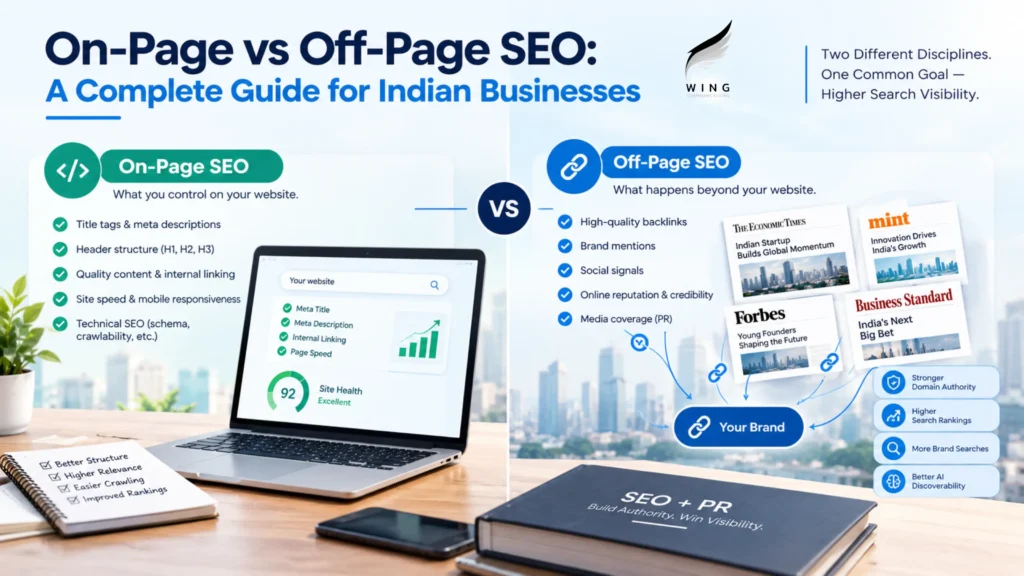
On-page vs off-page SEO comparison showing website optimization, backlinks, digital PR, and search visibility.

On-Page vs Off-Page SEO: A Complete Guide for Indian Businesses

On-Page vs Off-Page SEO: A Complete Guide for Indian Businesses

On-page vs off-page SEO comparison showing website optimization, backlinks, digital PR, and search visibility.

Founders often approach SEO as a single discipline, then get confused when an agency’s proposal only addresses half of it. That confusion usually comes down to a basic but underexplained distinction: on-page and off-page SEO are different disciplines, solving different problems, often requiring different partners entirely. Understanding where one ends and the other begins makes it far easier to hire correctly — and to know what a PR partner can and can’t do for your search visibility.

What On-Page SEO Actually Covers

On-page SEO is everything a company controls directly on its own website — page titles, meta descriptions, header structure, internal linking, content quality, site speed, mobile responsiveness, and technical elements like schema markup. It’s fundamentally an engineering and content discipline. A well-executed on-page strategy ensures search engines can crawl a site efficiently and understand what each page is about.

This is foundational work, and it’s a prerequisite — a company with excellent off-page authority but a technically broken website will still struggle to rank, because search engines can’t properly index or evaluate content they can’t crawl well. On-page SEO is typically handled by web development teams, technical SEO specialists, or content teams working closely with developers.

What Off-Page SEO Actually Covers

Off-page SEO is everything that happens outside a company’s own website that signals credibility and authority to search engines — primarily backlinks from other sites, but also brand mentions, social signals, and the broader pattern of how a company is referenced across the web. This is where the discipline overlaps directly with public relations, often more than founders realize.

The strongest off-page signal search engines evaluate is the backlink profile — specifically, how many credible, high-authority domains link back to a company’s site, and in what context. A link earned through genuine editorial coverage in a Tier-1 business publication carries meaningfully more weight than dozens of links from low-authority directories or guest-post farms, which search engines have gotten increasingly effective at discounting.

This is precisely where PR functions as off-page SEO infrastructure, whether or not a company frames it that way. Earned media coverage — a founder byline in a business publication, a feature story referencing the company, a quote in an industry trend piece — produces exactly the kind of high-authority, contextually relevant backlinks that off-page SEO is built to capture. Unlike manufactured link-building tactics, these can’t be purchased or gamed without undermining the credibility that gives them value.

Why This Distinction Matters for Hiring Decisions

Many Indian businesses hire a single “SEO agency” expecting it to handle both disciplines equally well. In practice, on-page technical work and off-page authority-building require genuinely different skill sets — one is closer to web development and content engineering, the other is closer to media relations and narrative strategy. An agency strong in one is rarely equally strong in the other, and generalist packages often underdeliver on the off-page side specifically, because building genuine editorial relationships takes years, not a monthly retainer alone.

For companies with a technically solid website but weak organic visibility, the gap is frequently on the off-page side — insufficient credible backlinks and insufficient third-party validation — rather than anything fixable through further on-page tweaks.

The AI Discoverability Layer

Off-page signals matter for a second, newer reason. AI-driven search tools and answer engines draw heavily on how a brand is discussed across credible external sources when constructing responses about it — a dynamic that closely mirrors how off-page SEO has always worked, just applied to a different kind of output. A company with strong on-page optimization but minimal earned media presence may rank reasonably in traditional search while remaining largely invisible or poorly represented in AI-generated answers, which increasingly draw on the same off-page credibility signals.

A Practical Way to Think About It

On-page SEO ensures a company’s website is technically capable of ranking. Off-page SEO — and specifically, the earned media coverage that produces genuine backlink authority — determines whether search engines, and increasingly AI tools, actually trust that company enough to rank or reference it prominently. Both matter, but they require different expertise, and treating them as a single undifferentiated service usually means one half is being handled by generalists rather than specialists.

Wing Communications operates specifically on the off-page, earned-media side of this equation — building the founder positioning, story placements, and Tier-1 backlink authority that strengthen a company’s broader search and AI discoverability, working alongside whatever technical or on-page SEO function a company already has in place.

FAQs

On-page SEO focuses on optimizing elements within your website, such as content, title tags, internal links, and technical structure. Off-page SEO focuses on external signals, including quality backlinks, brand mentions, and earned media coverage, that help establish credibility and authority.

Both are important. On-page SEO helps search engines crawl, understand, and index your website, while off-page SEO helps build authority and credibility. A balanced strategy combines both approaches.

Key elements include title tags, meta descriptions, heading structure, high-quality content, internal linking, image alt text, mobile responsiveness, page speed, schema markup, and crawlability.

Off-page SEO includes high-quality backlinks, digital PR, editorial media coverage, relevant brand mentions, reputation signals, and other credible references to your business across the web.

Digital PR helps businesses earn media coverage, editorial backlinks, and credible third-party mentions. These can strengthen a website’s backlink profile, support brand authority, and contribute to long-term search visibility.

Contact WingComm today to schedule a free strategy consultation and discover the right PR mix for your business.

On-Page vs Off-Page SEO: A Complete Guide for Indian Businesses Read More »

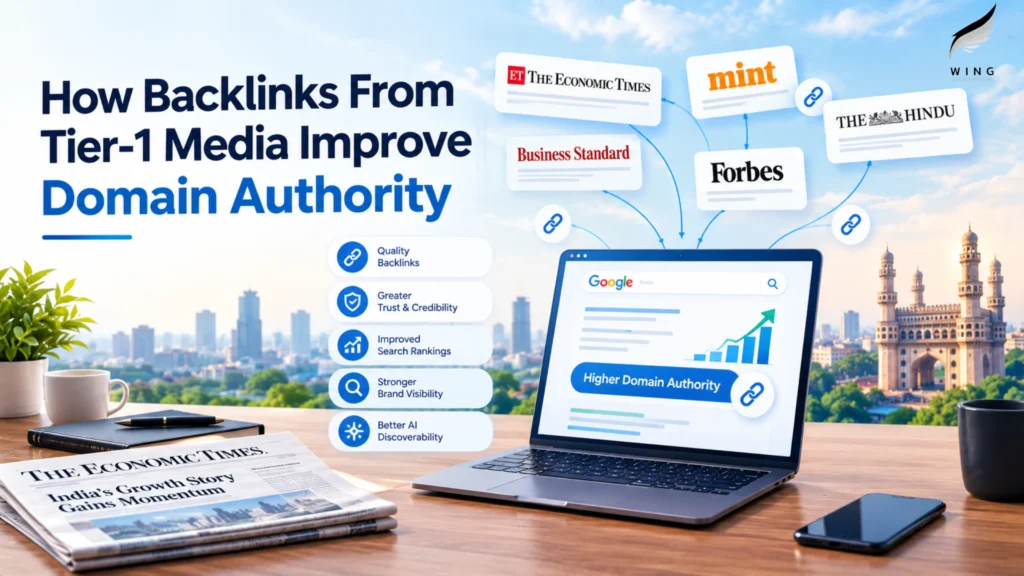
Tier-1 media backlinks improving domain authority, SEO, and online visibility

How Backlinks From Tier-1 Media Improve Domain Authority

How Backlinks From Tier-1 Media Improve Domain Authority

Tier-1 media backlinks improving domain authority, SEO, and online visibility

Most founders understand backlinks in the abstract — more links pointing to your site, better your search rankings. Fewer understand why a single link from a publication like Economic Times or Mint can matter more than fifty links from smaller sites combined. That difference isn’t just theoretical. It’s how search engines actually evaluate credibility, and it has direct implications for how companies should think about earned media, not just as reputation-building, but as SEO infrastructure.

Why Not All Backlinks Are Equal

Search engines evaluate backlinks using a concept broadly known as domain authority — essentially, how trustworthy and established the linking site itself is. A link from a domain with decades of credible publishing history, strong editorial standards, and broad readership carries substantially more weight than one from a low-authority blog or a directory built purely for link placement.

This is why one link from a Tier-1 business publication can outperform a much larger number of links from smaller or less credible sources. Google’s algorithms have gotten increasingly sophisticated at recognizing which links reflect genuine editorial judgment versus which were placed purely for SEO manipulation — and they weight them accordingly.

Earned Links vs. Built Links

There’s a structural difference between links a company earns and links it builds. Built links — guest posts on marginal sites, paid link placements, directory submissions — have become progressively less effective as search engines have refined their ability to detect patterns associated with manipulation. Many of the link-building tactics that worked five years ago now carry more risk than benefit.

Earned links are different because they can’t be manufactured the same way. A journalist at a Tier-1 publication links to a company because there’s a genuine editorial reason to — a data point worth citing, a source worth crediting, a company worth referencing as an example within a larger story. That authenticity is precisely what search engines are trying to identify and reward.

The Compounding Effect

A single Tier-1 backlink rarely transforms search performance on its own. What matters is the cumulative pattern over time — a company that consistently earns coverage across multiple credible publications builds a backlink profile that search engines read as sustained third-party trust, not a one-time spike. This compounding effect tends to show up gradually: improved rankings not just for branded search terms, but for competitive category keywords the company is trying to own.

This is one of the more underappreciated arguments for treating PR as a long-term function rather than a campaign tied to a single announcement. The SEO value of earned coverage accrues slowly, in the same way the credibility value does — through consistency, not intensity.

Beyond Rankings: What Else These Backlinks Signal

Tier-1 backlinks don’t just influence search rankings. They also function as a durable trust signal for anyone researching a company directly — an investor doing diligence, an enterprise buyer’s procurement team, a journalist deciding whether a company is worth covering themselves. A company referenced and linked by Economic Times or Business Standard carries an implicit credibility that a founder’s own website copy can’t replicate, regardless of how well-written it is.

The AI Discoverability Dimension

There’s a newer layer to this worth understanding. AI-driven search and answer engines — ChatGPT, Perplexity, Google’s AI Overviews — draw on patterns of credible third-party content when forming responses about a company or industry. A strong backlink profile from established media isn’t just a search engine ranking factor anymore; it’s part of how a brand gets represented, or fails to get represented, in AI-generated answers. Companies with minimal Tier-1 coverage risk being invisible or inaccurately described in a research channel a growing number of buyers and investors now use.

What This Means for PR Strategy

Given this, story pitching shouldn’t be disconnected from a company’s broader digital visibility goals. A story angle chosen partly with awareness of which topics and keywords matter for search — while still being genuinely newsworthy on its own merits — produces coverage that serves both reputation and SEO simultaneously. This requires PR and content strategy to coordinate more closely than they traditionally have, rather than operating as entirely separate functions.

A Realistic Framing

Backlinks from Tier-1 media are a byproduct of genuine, earned coverage — not something that can be purchased or manufactured without undermining the very credibility that gives them value in the first place.

Wing Communications builds its earned media strategy with this dual outcome in mind — pursuing story placements that build reputation and founder authority while contributing, over time, to the kind of durable domain authority that supports a company’s broader search and AI discoverability goals.

FAQs

Tier-1 media backlinks are links to your website from highly credible, established publications and news platforms. These links are typically earned through genuine editorial coverage, interviews, expert commentary, or newsworthy stories.

Yes, high-quality backlinks from credible publications can strengthen a website’s overall backlink profile and contribute to stronger domain authority and search visibility over time.

Quality matters more than quantity. A backlink from a trusted, authoritative publication can provide stronger credibility and SEO value than numerous links from low-quality or irrelevant websites.

They can strengthen your backlink profile, improve perceived website credibility, support search visibility, and help search engines better understand your brand and its authority within a relevant industry.

Businesses can earn these backlinks through strategic digital PR, newsworthy announcements, expert commentary, founder thought leadership, original research, interviews, and relevant media pitches.

Contact WingComm today to schedule a free strategy consultation and discover the right PR mix for your business.

How Backlinks From Tier-1 Media Improve Domain Authority Read More »