
Custom Website Development: What Every Growing Brand Needs to Know
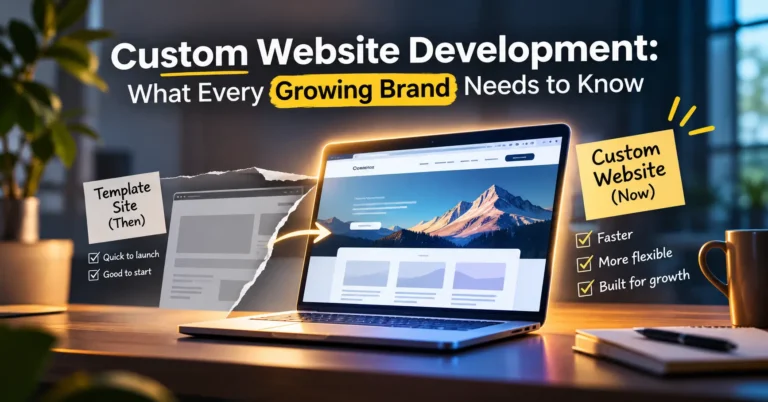
A company’s website is often the first genuinely thorough impression it makes — arriving after a press mention, a referral, or a search, and expected to confirm in seconds what the earlier touchpoint suggested. Yet many growing Indian brands are still running on templated builds chosen for speed at an earlier stage, never revisited as the company’s ambitions outgrew them. Knowing when and how to move to a custom build is a decision worth making deliberately, not reactively.
Why "Custom" Matters More at Growth Stage
Early-stage companies reasonably default to templated platforms — fast to launch, low cost, sufficient for validating an idea. The calculus changes once a company has real traction. A templated site starts showing its limits in ways that matter commercially: slower load times as content grows, rigid design constraints that make it hard to reflect an evolving brand, and technical ceilings on integrations — CRM connections, analytics depth, custom functionality — that a growing company increasingly needs.
Custom development solves for the specific needs of the business rather than the generic needs of “a website,” which is precisely the gap that starts to show once a brand has outgrown its first build.
What Actually Matters in a Custom Build
Performance from the ground up. Site speed directly affects both user experience and search ranking. A custom build allows deliberate control over what loads, how, and when — something templated platforms with heavy third-party plugin dependencies often can’t optimize as cleanly.
Scalable architecture. A growing brand’s needs six months from launch rarely match its needs at launch. Custom development done properly anticipates this — building a structure that can absorb new content types, additional pages, and evolving functionality without requiring a rebuild each time the company changes.
Design that reflects actual brand positioning. Templated themes, however well-chosen, carry inherent visual similarity to every other site built on the same theme. For a brand investing in distinct positioning — through PR, founder visibility, or market differentiation — a website that looks interchangeable with competitors undercuts that investment. Custom design closes this gap.
Technical SEO built in properly. Clean code structure, proper schema markup, and sensible information architecture are considerably easier to implement correctly in a custom build than to retrofit onto a templated site loaded with plugins built for general use rather than a specific company’s structure.
Integration flexibility. As companies mature, they typically need their website to connect cleanly with CRM systems, marketing automation, analytics stacks, and sometimes internal tools. Custom builds are generally easier to integrate deeply, compared to templated platforms that often require workaround plugins with their own limitations.
Where Growing Brands Get This Wrong
Rebuilding before it’s actually necessary. Not every growing company needs a full custom build immediately — sometimes a well-executed redesign on an existing platform solves the immediate problem more efficiently. The decision should follow a genuine audit of specific limitations being hit, not a general sense that the current site “looks dated.”
Treating the website as a one-time project. A custom build isn’t a finished asset — it requires ongoing maintenance, security updates, and periodic content and structural updates as the company evolves. Companies that treat launch as the finish line often find the site drifting out of date within a year or two.
Underinvesting in the pages that carry the most weight
FAQs
A media coverage report summarizes a company’s press mentions, editorial features, interviews, founder quotes, and other media placements. A detailed report also evaluates coverage quality, publication relevance, visibility trends, backlinks, and potential business impact.
Start by reviewing publication quality rather than total article count. Then check whether coverage is earned or paid, assess the relevance of each story, compare founder and brand visibility, examine trends over time, and review backlinks and search performance.
Earned media is coverage gained through independent editorial interest, such as interviews, features, and expert quotes. Paid media includes sponsored articles, advertisements, and other placements purchased by a company. Both can support communications goals, but they should be reported separately.
A high number of placements does not necessarily indicate strong PR performance. Coverage in credible, relevant publications can provide more meaningful opportunities to build trust, establish expertise, and reach important stakeholders than numerous low-value or syndicated mentions.
Contact WingComm today to schedule a free strategy consultation and discover the right PR mix for your business.