Why Earned Media Should Be Part of Your Marketing Budget, Not an Afterthought
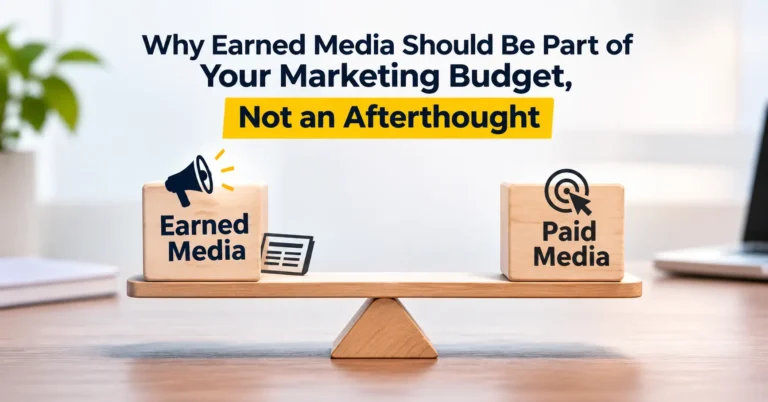
Ask most growing Indian companies to break down their marketing budget, and PR is usually one of two things: a small discretionary line item, or entirely absent until something goes wrong and a crisis response is suddenly needed urgently. Meanwhile, paid social and performance advertising typically absorb the majority of spend, treated as the default engine of growth. That allocation reflects habit more than strategy — and it’s increasingly costing companies more than it needs to.
Why This Allocation Pattern Persists
Paid advertising is easy to justify in a budget conversation. It has a dashboard, a clear cost-per-result, and a familiar logic — spend more, get more reach. PR doesn’t offer that same immediate, attributable feedback loop, which makes it harder to defend in a planning meeting, even when its actual business impact is significant. The result is a systemic underinvestment in earned media, not because it doesn’t work, but because it’s harder to justify in the same spreadsheet logic as a paid campaign.
What Gets Missed When PR Is an Afterthought
Rising paid acquisition costs, with no counterbalance. Costs per click and cost per lead have climbed steadily across most competitive Indian categories. Companies relying almost entirely on paid channels are increasingly paying more for the same results, with no complementary channel building the kind of trust that makes an ad convert better in the first place. Earned coverage does exactly that — a prospective customer or investor who’s already encountered a company through credible press is measurably easier to convert than one encountering the brand cold through an ad.
No credibility reserve when it’s needed most. Companies that treat PR as crisis-only find themselves building a public narrative from scratch under pressure — during a funding round, a leadership transition, or an actual crisis — precisely when there’s no time to build it properly. A modest, consistent PR investment beforehand means there’s already a credible track record to draw on when it matters.
Weaker compounding effects. Paid advertising results largely stop the moment spend stops. Earned media compounds — a strong piece of coverage continues generating backlink value, search visibility, and referenceable credibility long after the initial placement. Budgets that don’t account for this differential tend to systematically undervalue PR relative to its longer-term return.
What a More Balanced Allocation Looks Like
There’s no universal formula, since it depends heavily on stage and goals — a company chasing immediate lead volume genuinely needs more weighted toward performance channels than one building toward a funding round or enterprise sales credibility. But the useful shift for most growing Indian brands is moving PR from a discretionary, ad hoc line item to a planned, consistent monthly allocation — even a modest one — rather than a bucket that only gets funded when there’s budget left over from paid campaigns.
A retainer-based PR engagement, planned quarterly alongside paid spend, allows a company to build earned credibility steadily rather than in the sporadic bursts that come from treating it as an afterthought.
The AI Discoverability Argument for Budgeting This Properly
There’s a newer, forward-looking reason this allocation matters. Paid advertising has no bearing on how a brand is represented in AI-generated search and answer tools — those systems draw on credible, published third-party content, which is precisely what earned media produces and what advertising cannot. A company investing heavily in paid acquisition but nothing in earned coverage may find itself increasingly invisible in a research channel that a growing share of investors, enterprise buyers, and customers now use before making a decision.
A Practical Starting Point
The point isn’t to abandon paid social or performance advertising — both remain legitimate, necessary tools for many growth goals. The point is recognizing that a marketing budget with no planned allocation for earned media is building growth on a single, increasingly expensive channel, with no credibility infrastructure supporting it.
Wing Communications works with growing Indian brands to build PR into the marketing budget as planned, ongoing infrastructure — not a crisis response or a leftover line item — so earned credibility compounds alongside, rather than after, paid growth efforts.
FAQs
A media coverage report summarizes a company’s press mentions, editorial features, interviews, founder quotes, and other media placements. A detailed report also evaluates coverage quality, publication relevance, visibility trends, backlinks, and potential business impact.
Start by reviewing publication quality rather than total article count. Then check whether coverage is earned or paid, assess the relevance of each story, compare founder and brand visibility, examine trends over time, and review backlinks and search performance.
Earned media is coverage gained through independent editorial interest, such as interviews, features, and expert quotes. Paid media includes sponsored articles, advertisements, and other placements purchased by a company. Both can support communications goals, but they should be reported separately.
A high number of placements does not necessarily indicate strong PR performance. Coverage in credible, relevant publications can provide more meaningful opportunities to build trust, establish expertise, and reach important stakeholders than numerous low-value or syndicated mentions.
Contact WingComm today to schedule a free strategy consultation and discover the right PR mix for your business.