
How to Build a Consistent Brand Voice Across Social Platforms
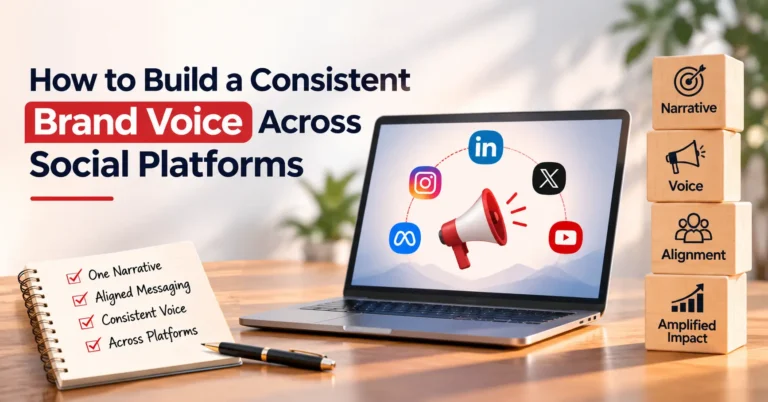
Most conversations about brand voice start with tone — casual or formal, playful or serious. That’s the surface layer. The deeper problem most companies actually have isn’t tone inconsistency; it’s narrative inconsistency — a brand that sounds fine on any single platform but tells a slightly different story about itself depending on where you encounter it. That’s a communications problem before it’s a social media problem, and it’s usually rooted in how a company’s core messaging was built in the first place.
Voice Follows Narrative, Not the Other Way Around
A common mistake is treating brand voice as a style guide exercise — approved adjectives, sentence length preferences, an emoji policy. Useful, but downstream of a bigger question: what is this company’s actual story, and does everyone writing on its behalf understand it the same way? A precise tone applied to an unclear or shifting narrative just produces consistently confusing content.
The companies with genuinely coherent brand voice usually have a clear point of origin — a founder narrative, a specific market position, a defined problem the company exists to solve — that every piece of content, regardless of platform or format, traces back to. Voice consistency is really narrative discipline wearing a stylistic coat.
Where Indian Brands Commonly Fragment
Different teams, no shared source material. Social media, PR, and content marketing are frequently run by separate people or separate vendors with limited coordination. A founder’s carefully positioned narrative from a media interview doesn’t make it into the social team’s content brief, so the LinkedIn post ends up telling a slightly different, less precise version of the same story.
Reactive posting without a reference point. Teams under pressure to post consistently often generate content in the moment, disconnected from the company’s actual established positioning — resulting in technically on-brand tone but strategically off-message content.
Founder voice versus company voice, unreconciled. Many Indian companies run both a founder’s personal presence and a company account, often with different people managing each, and no clear alignment on which narrative points belong where. Audiences following both notice the disconnect, even if they can’t articulate exactly what feels off.
Building It Properly
Start from earned narrative, not a style guide. The most reliable source for a consistent brand voice is the story that’s already been tested and validated externally — through media coverage, founder interviews, and press positioning. If a founder’s narrative has already been refined through genuine media conversations, that refined version should anchor everything else, rather than each platform inventing its own framing independently.
Create one shared reference document, not separate briefs per platform. A single source — core positioning, key messages, founder’s established point of view, language to avoid — should inform social content, PR pitches, and website copy alike. Platform-specific formatting can vary; the underlying narrative shouldn’t.
Treat founder and brand voice as connected, not identical. A founder’s personal voice can be more opinionated and informal than a corporate account’s, but the substance — the positioning, the point of view on the industry — should align. Divergence in tone is fine. Divergence in narrative is a problem.
Audit before adding more content. Before producing more social content, it’s worth reviewing what’s already out there — across the company page, the founder’s profile, recent press coverage — and checking whether it tells one coherent story or several competing ones. Most brands are surprised by how much drift has accumulated without anyone noticing in real time.
Why This Matters Beyond Social Media
A consistent narrative doesn’t just make a brand look more polished — it directly affects how the brand is understood by search engines and AI tools evaluating consistency across sources. A company that’s described one way in press coverage, another way on its own social channels, and a third way in its website copy makes it harder for these systems to form a clear, accurate picture — which increasingly shapes how a brand is represented in AI-generated answers about it.
Google’s Organization structured data guidelines provide additional context on how clearly identifying an organisation helps search engines understand its identity.
A Practical Starting Point
Brand voice consistency isn’t primarily a content calendar problem. It’s a narrative alignment problem that shows up on content calendars. Getting the underlying story right — and making sure PR, founder positioning, and social content are all drawing from the same source — solves the tone inconsistency almost as a byproduct.
Research from the Nielsen Norman Group on tone of voice also highlights how communication tone influences perceptions of brand trustworthiness and desirability.
Wing Communications approaches this by anchoring a client’s social and public-facing voice in the same core narrative built through earned media and founder positioning work — so a brand sounds like one consistent story, whether encountered in a press feature, a founder’s post, or a company update.
FAQs
A media coverage report summarizes a company’s press mentions, editorial features, interviews, founder quotes, and other media placements. A detailed report also evaluates coverage quality, publication relevance, visibility trends, backlinks, and potential business impact.
Start by reviewing publication quality rather than total article count. Then check whether coverage is earned or paid, assess the relevance of each story, compare founder and brand visibility, examine trends over time, and review backlinks and search performance.
Earned media is coverage gained through independent editorial interest, such as interviews, features, and expert quotes. Paid media includes sponsored articles, advertisements, and other placements purchased by a company. Both can support communications goals, but they should be reported separately.
A high number of placements does not necessarily indicate strong PR performance. Coverage in credible, relevant publications can provide more meaningful opportunities to build trust, establish expertise, and reach important stakeholders than numerous low-value or syndicated mentions.
Contact WingComm today to schedule a free strategy consultation and discover the right PR mix for your business.