
Why Your Media Coverage Belongs in Your Investor and Customer Updates
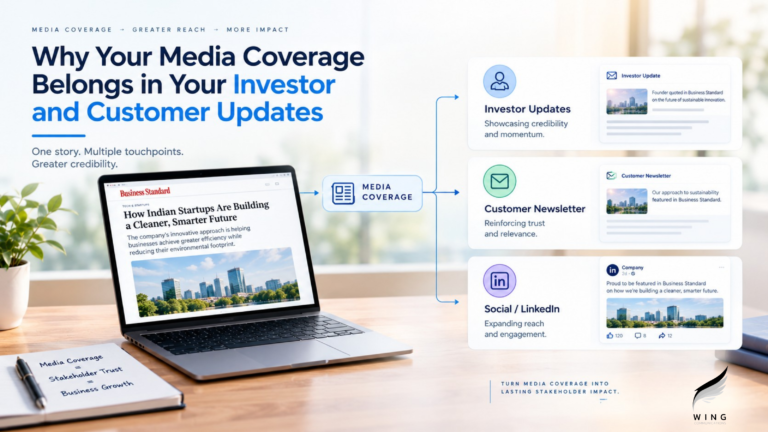
Most companies treat media coverage as a one-time asset — a link shared on LinkedIn, maybe added to a website’s “in the news” page, and then forgotten. Meanwhile, the same company sends monthly investor updates and customer newsletters that rarely reference the coverage at all. That’s a missed opportunity. Earned media doesn’t just build external credibility — it’s some of the strongest content a company already has sitting unused in its own stakeholder communications.
Why This Gap Exists
PR and email communications are usually run by different people, sometimes different teams entirely, with no real handoff between them. A founder secures a feature in a business publication, the PR team reports it as a placement win, and the story ends there. Nobody loops it into the investor update going out three weeks later, or the customer newsletter that could use exactly this kind of third-party validation. The coverage exists, but it never reaches the audiences who’d find it most persuasive.
Why Media Coverage Belongs in Investor Updates Specifically
Investors — current and prospective — read updates looking for signals of momentum and credibility, not just metrics. A line in a monthly update noting that the founder was quoted in Mint on an industry trend, or that the company was featured in a Business Standard piece on sector consolidation, does something a growth chart alone can’t: it shows the company is being recognized by an independent, credible third party, not just reporting its own numbers.
This matters more ahead of a funding round. Investors doing diligence often search a company’s name before a first meeting. A founder who’s proactively surfaced relevant coverage in prior updates has already shaped part of that research — rather than leaving an investor to stumble on it cold, or not find it at all.
Why It Belongs in Customer Communications Too
For B2B companies particularly, a customer newsletter that references credible third-party coverage — a founder’s byline on an industry challenge, a feature explaining the company’s approach to a known problem — reinforces trust in a way product updates alone don’t. Customers renewing a contract or considering an upsell respond differently to “our founder was recently featured discussing this exact challenge” than to another feature announcement.
This doesn’t mean turning every email into a press digest. It means treating genuinely relevant coverage as legitimate content, worth a line or a short section, rather than something that only lives on a website’s press page. Effective email newsletter writing can help keep these updates relevant and useful to their intended audience.
How to Actually Do This Well
Be selective, not exhaustive. Not every piece of coverage belongs in every update. A wire syndication pickup with limited editorial substance isn’t worth including. A genuine feature, a founder byline, or a credible quote placement usually is. Curating rather than listing everything keeps the update credible instead of cluttered.
Frame it for the reader, not the company. Rather than “we were featured in X,” a stronger frame connects the coverage to something the reader cares about — “here’s how [publication] covered the shift we’ve been building toward,” positioning the coverage as insight the reader benefits from, not just a company win being announced.
Keep the cadence realistic. If coverage is sparse in a given month, it’s fine to skip this section entirely rather than stretching a minor mention to fill space. Forced inclusion undermines the credibility this is meant to build.
Link back to the original source. Beyond the immediate communication value, this reinforces the backlink and referral traffic value of the original coverage — a secondary benefit that compounds when stakeholders click through to the actual publication.
The Broader Point
This is really about recognizing that earned media has a longer useful life than most companies give it credit for. A single piece of coverage can serve a press page, a sales conversation, a LinkedIn post, an investor update, and a customer newsletter — but only if someone is deliberately connecting PR output to the rest of a company’s stakeholder communications, rather than treating PR as a siloed function that stops mattering once the article is published.
Companies that do this well tend to get more return from the same volume of coverage than companies generating just as much media attention but leaving it stranded on a press page nobody revisits.
Wing Communications works with founders to think about earned coverage this way — not as an isolated deliverable, but as reusable credibility infrastructure that should show up everywhere a company is already talking to the people who matter most, from investor updates to customer communications. Explore Wing Communications’ thought leadership services and media relations services to learn more about building visibility and credibility through strategic communications.
FAQs
Media coverage provides independent third-party validation of a company’s progress, leadership, and industry relevance. Including credible press mentions in investor updates helps communicate momentum and strengthen investor confidence.
Coverage in reputable publications can demonstrate that a company and its leadership are gaining industry recognition. It can also give investors additional context about the business, market position, and expertise beyond internal performance reports.
Sharing relevant media coverage reinforces credibility and helps customers understand the company’s expertise, industry contributions, and approach to solving business challenges. It adds third-party validation alongside product news and company updates.
Companies should prioritize credible editorial features, founder interviews, expert commentary, and thought leadership articles in relevant publications. Coverage should be useful to the intended audience rather than included simply to increase the number of press mentions.
Contact WingComm today to schedule a free strategy consultation and discover the right PR mix for your business.