
SEO vs PR: Why Combining Both Gets You Faster Google Rankings
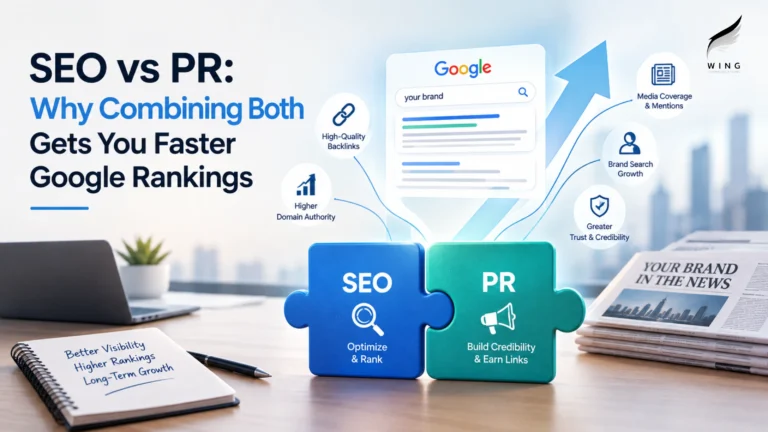
SEO teams and PR teams have historically operated in separate rooms, sometimes in separate companies entirely. One optimizes meta descriptions and internal linking structures. The other pitches journalists and builds media relationships. That separation made sense when the two disciplines produced genuinely different outcomes. It makes far less sense now — because the outcomes have started overlapping in ways most companies haven’t fully adjusted to.
Why This Isn't Really a Competition
Framing SEO and PR as competing approaches misunderstands what each actually does. SEO is a technical and content discipline focused on how search engines crawl, index, and rank a website. PR is a credibility and narrative discipline focused on earning third-party coverage and trust. They solve different problems — but one increasingly reinforces the other in ways that matter for both.
The Mechanism: How PR Actually Moves SEO
Search engines, particularly Google, weight backlinks from credible, high-authority domains as a signal of trustworthiness. A backlink from a well-established business publication carries meaningfully more weight than one from a low-authority blog or directory — not just in volume, but in the quality signal it sends. Earned media coverage in genuine editorial contexts, where a company is referenced organically within a journalist’s story, produces exactly this kind of high-authority linking, over time.
This is different from the backlink-building tactics SEO teams have relied on for years, many of which have become less effective as search engines have gotten better at identifying manipulative link networks. Earned coverage, by contrast, can’t easily be gamed — a journalist chooses to reference a company because there’s a genuine reason to, which is precisely why it holds weight.
Beyond Backlinks: Brand Search Signals
There’s a second, less discussed mechanism. When a company is covered across multiple credible publications, it increases what’s sometimes called brand search volume — people searching the company name directly after encountering it in an article. Search engines interpret consistent branded search activity as a trust signal in its own right, independent of the backlinks themselves. This is one reason companies with strong PR often see gradual improvement in their own domain’s search performance, even on pages unrelated to the specific coverage.
Where This Matters Most for Indian Companies
For startups and growth-stage companies competing in crowded categories — fintech, EdTech, D2C, enterprise SaaS — organic search visibility is expensive to win through content alone, given how saturated most keyword categories have become. Earned media coverage offers a parallel path: build authority through credible third-party validation, which compounds into stronger domain authority and, over time, better organic rankings for the terms that matter.
This is particularly relevant in categories where paid search costs have risen sharply. A company that’s invested in building genuine editorial credibility often finds its organic performance more resilient and less dependent on continuously increasing ad spend.
The Newer Layer: AI Search and Discoverability
This overlap has become even more pronounced with the rise of AI-driven search — ChatGPT, Perplexity, Google’s AI Overviews. These systems don’t just crawl a company’s own website; they draw heavily on how a brand is discussed across credible third-party sources. A company with strong earned media coverage is more likely to be accurately and favorably represented when someone asks an AI tool a question relevant to its category. A company with a thin media footprint, however strong its own website content, risks being underrepresented or misrepresented in these AI-generated answers.
This is arguably the strongest current argument for treating PR as core SEO infrastructure, not an adjacent discipline. Technical SEO can only optimize what a search engine finds on a company’s own site. It can’t manufacture the third-party credibility that increasingly drives both traditional rankings and AI visibility.
What This Means Practically
Companies serious about long-term search visibility should stop treating SEO and PR as separate budget lines run by separate teams with separate KPIs. A coordinated approach — where PR story angles are chosen with awareness of the search terms and topics a company wants to own, and SEO content strategy accounts for the authority PR coverage is building — produces compounding results neither discipline achieves as effectively alone.
Wing Communications builds its earned media strategy with this overlap in mind — treating story placement, founder positioning, and coverage cadence not just as reputation-building, but as a deliberate contributor to a company’s long-term search and AI discoverability, working alongside whatever SEO function a company already has in place.
FAQs
SEO focuses on improving a website’s visibility in search engines through technical optimization, content, internal linking, and other search-focused practices. PR focuses on building credibility and visibility through earned media, journalist relationships, and third-party coverage.
PR can support SEO by earning coverage and backlinks from relevant, credible publications. It can also increase brand awareness and generate searches for the company or its products.
Relevant editorial backlinks from credible websites can contribute to a website’s authority and search visibility. The value depends on the quality and relevance of the referring publication rather than simply the number of links.
PR can contribute to SEO performance by generating quality backlinks, brand mentions, and increased awareness. However, rankings depend on many factors, so PR alone cannot guarantee higher Google positions.
SEO and PR can complement each other. SEO can identify important topics and search opportunities, while PR can help earn authoritative coverage and third-party references around those topics.
Contact WingComm today to schedule a free strategy consultation and discover the right PR mix for your business.