Tier-1 Media Coverage: Why It Matters and How Startups Can Earn It
Every founder wants their company in the Economic Times or Business Standard. Few can articulate why, beyond a vague sense of prestige. That vagueness is a problem — because Tier-1 coverage, pursued without a clear strategic reason, often ends up being expensive validation-seeking rather than a genuine business asset.
Understood correctly, Tier-1 media matters for concrete reasons. Here’s what those are, and what it actually takes to earn that coverage.
What "Tier-1" Actually Means
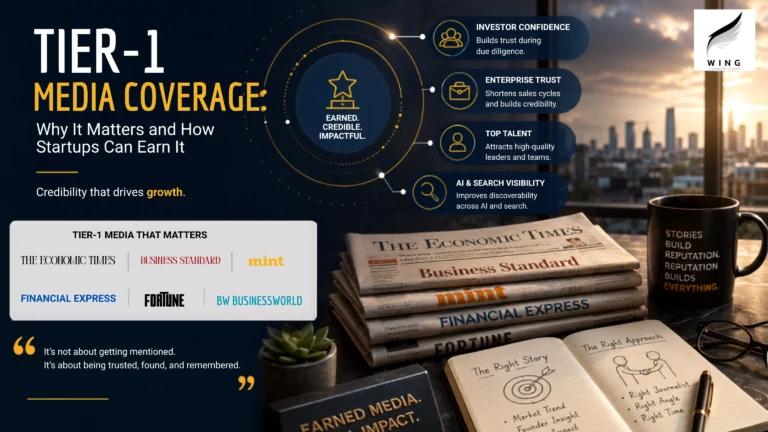
In the Indian context, Tier-1 typically refers to national business and financial publications — Economic Times, Business Standard, Mint, Financial Express, Fortune India, BW Businessworld — along with business television and flagship digital business media. These outlets have institutional credibility with investors, enterprise buyers, and other journalists. A mention here carries weight a niche trade publication or a smaller digital outlet simply doesn’t.
That weight is precisely why access is harder. These publications receive far more pitches than they can run, and their reporters are selective about what qualifies as genuinely newsworthy rather than promotional.
Why It Actually Matters — Beyond Prestige
Investor diligence. When an investor researches a company ahead of a term sheet, credible business media coverage functions as a form of third-party validation. It doesn’t replace due diligence, but consistent, substantive coverage signals that a company has a real story worth telling — and that other serious outlets have found it credible enough to cover.
Enterprise sales cycles. For B2B and enterprise-facing companies, a prospective client’s procurement or leadership team often does a quick credibility check before a serious conversation. Tier-1 coverage shortens that trust-building process.
Talent attraction. Senior hires increasingly research a company’s public narrative before joining, particularly at the leadership level. A company with a credible media footprint signals stability and ambition in a way a polished careers page alone cannot.
AI and search visibility. This is the newer, less obvious reason. Language models and AI search tools weight information from established, credible publications more heavily when forming an understanding of a brand. A company with strong Tier-1 coverage is more likely to be represented accurately — and favorably — when someone asks an AI tool about it. This is becoming a genuine long-term SEO and discoverability lever, not just a reputational one.
Why Most Startups Fail to Earn It
The most common mistake is pitching Tier-1 media the same way a company might pitch a niche startup blog — leading with the product, the funding round, or a generic “we’re disrupting X” framing. Tier-1 journalists are looking for a broader story: a market trend, a regulatory shift, a founder perspective on where an industry is heading, or a data point that says something about the economy, not just the company.
The second mistake is inconsistency. A single well-placed pitch around a funding announcement, followed by months of silence, doesn’t build the kind of relationship that leads to repeat coverage. Journalists remember founders and companies that are reliable, quotable sources over time — not just around their own news cycles.
What Actually Earns Tier-1 Coverage
A story bigger than the company. The strongest pitches position the company as evidence of a larger trend — the shift toward EV logistics in industrial supply chains, the AI-native transformation of legal operations, the changing economics of enterprise testing. The company becomes the proof point, not the pitch itself.
Founder-led narrative. Business journalists are often more interested in a founder’s perspective — on regulation, on where an industry is broken, on a contrarian read of a market — than in the company’s product roadmap. Positioning founders as sources for ongoing industry commentary, not just spokespeople for their own news, builds the kind of relationship that leads to being called for quotes independent of any specific announcement.
Precision over volume. A tightly targeted pitch to the right reporter, timed against a relevant news cycle, consistently outperforms a mass press release blast. Tier-1 journalists can tell the difference immediately.
Patience and consistency. Tier-1 relationships are built over quarters, not weeks. Agencies and founders who treat it as a long game — building credibility through smaller wins, consistent story pitching, and genuine industry insight — earn access that a single
A Realistic Framing
Tier-1 coverage isn’t guaranteed by any agency, and any promise otherwise should be treated skeptically — editorial discretion always sits with the journalist. What can be built is the discipline behind it: sharper story angles, consistent outreach, and founder positioning strong enough to earn a journalist’s attention on its own merit.
Wing Communications approaches Tier-1 media this way — as an outcome of sustained narrative strategy rather than a one-off placement push, built around the story angles and founder positioning that make coverage worth earning in the first place.
FAQs
Tier-1 typically means national business and financial publications — Economic Times, Business Standard, Mint, Financial Express, Fortune India, and BW Businessworld — along with flagship business TV and digital outlets that carry institutional credibility with investors and enterprise buyers.
It shortens investor diligence, speeds up enterprise sales credibility checks, strengthens talent attraction, and increasingly shapes how AI search tools and language models represent a brand when people ask about it.
Tier-1 relationships are typically built over quarters, not weeks. Consistent, targeted pitching and founder positioning matter more than a single aggressive push.
The most common mistakes are leading with product or funding news instead of a broader market story, and pitching inconsistently — only reaching out around major announcements rather than building an ongoing relationship with journalists.
No — editorial discretion always sits with the journalist, so any agency promising guaranteed Tier-1 placement should be treated with skepticism. What a good agency can build is the strategy behind it: sharper story angles and consistent outreach.
6. Does Tier-1 media coverage help with SEO and AI visibility?
Contact WingComm today to schedule a free strategy consultation and discover the right PR mix for your business.