Digital Marketing Strategy: A 2026 Framework for Growing Brands
Every year brings a fresh wave of “the new rules of digital marketing” content, and most of it is noise dressed as insight. But a few genuine shifts are shaping how brands grow right now. One of the most significant is the growing importance of credibility and earned trust within what used to be a predominantly performance-driven discipline.
A modern digital marketing strategy needs to account for this shift. Beyond paid acquisition and organic traffic, brands must build credibility, strengthen their online presence, and improve how they are discovered across search engines and AI-powered platforms.
Why the Old Digital Marketing Framework Is Breaking Down
For years, digital marketing strategy meant a predictable combination of paid acquisition, SEO content, social media, email marketing, and conversion optimization. These channels remain important, but relying on them alone can limit growth.
Paid acquisition can become expensive in competitive markets. Content saturation makes it harder for a new article to stand out, while buyers increasingly use AI-powered tools alongside traditional search to research companies, products, and services.
According to Google’s guidance on AI features in Search, foundational SEO practices remain relevant to AI-powered search experiences. This reinforces the importance of technically accessible websites, helpful content, and clear information.
For brands, the opportunity is to treat credibility-building as a core part of digital marketing rather than an afterthought.
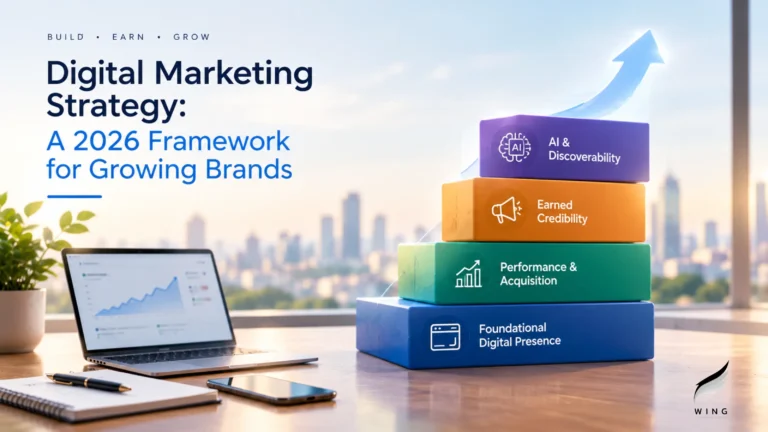
The Four Layers of a Digital Marketing Strategy for 2026
1. Foundational Digital Presence
The foundation includes a technically sound website, clear page structure, useful content, on-page SEO, and effective conversion paths.
Businesses should ensure that their websites are easy to navigate, mobile-friendly, accessible to search engines, and aligned with what their audiences are searching for.
Google’s SEO Starter Guide provides practical guidance on making website content easier for search engines to discover and understand.
For a deeper understanding of website optimization, businesses can also explore our guide to choosing the right PR and digital marketing agency in Hyderabad.
A strong digital presence helps a brand get discovered. However, visibility alone does not automatically establish trust.
2. Performance Marketing and Customer Acquisition
Paid search, paid social, and performance-focused content remain valuable for generating measurable actions such as enquiries, registrations, and sales.
These channels help businesses reach defined audiences, test messaging, and understand which campaigns contribute to conversions. Their effectiveness, however, depends on more than ad targeting and creative quality.
A potential customer may discover a company through an advertisement and then search for its reputation, leadership team, customer feedback, or media coverage before making a decision.
This is where brand credibility supports customer acquisition. When a business has a clear message and a credible external presence, its paid campaigns have more context to work with.
The objective is not to replace performance marketing but to strengthen it with a consistent brand narrative and trustworthy third-party references.
3. Earned Credibility Through Digital PR
Earned credibility is one of the most underappreciated layers of many digital marketing strategies.
Media coverage, founder thought leadership, expert commentary, and independent third-party references help audiences evaluate a brand beyond its own advertising and website claims.
A founder quoted in a relevant business publication or a company featured in an industry story gains an opportunity to demonstrate expertise in a credible editorial context.
Earned media can also support SEO when coverage generates relevant editorial backlinks. These links can help search engines discover pages and understand how websites connect to one another. Their value depends on relevance, context, and the quality of the linking source.
For more on this relationship, read our guide to what a PR agency does and how it builds brand credibility.
Businesses should prioritize genuine editorial coverage rather than manufactured links or low-quality link schemes. Google explains its approach to manipulative link practices in its spam policies for Google Search.
Founder positioning is another important part of this layer. Through expert articles, interviews, opinion pieces, and relevant media commentary, founders can build recognition around their knowledge and industry perspective.
Explore Wing Communications’ thought leadership services to understand how executive visibility and media positioning can support brand authority.
4. AI Discoverability and Brand Visibility
AI-powered search tools are creating additional ways for people to discover and evaluate businesses.
When users ask ChatGPT, Perplexity, or Google’s AI-powered search experiences about a company or industry, the information available across the web can influence how a brand is understood and represented.
This makes accurate company information, useful website content, consistent messaging, and credible external references increasingly relevant to digital visibility.
However, AI visibility is not guaranteed by media coverage alone. Each platform uses different systems, sources, and retrieval methods, so businesses should focus on strengthening their overall digital presence rather than chasing shortcuts.
Google’s official guidance on optimizing websites for generative AI features explains why established SEO fundamentals and original, helpful content remain important.
For a deeper look at this emerging discipline, explore Wing Communications’ Generative Engine Optimization (GEO) services.
Why the Order of Investment Matters
The four layers should work together, but they do not always require equal investment at the same time.
A business with technical website problems may need to address crawling, indexing, content structure, or conversion barriers before increasing acquisition spending. A company with a well-optimized website but limited brand recognition may benefit from stronger digital PR and thought leadership alongside its existing marketing activities.
Similarly, a business investing heavily in paid campaigns should evaluate whether its website, reputation, and external brand presence provide enough confidence for potential customers to take the next step.
A practical approach is to:
- Build the foundation: Ensure the website, content, and conversion paths are effective.
- Improve acquisition: Use paid and organic channels to reach relevant audiences.
- Establish credibility: Develop earned media opportunities, founder positioning, and relevant editorial coverage.
- Improve discoverability: Strengthen brand information and useful content across search and AI discovery channels.
- Measure and refine: Review performance data and adjust investment based on business objectives.
This sequence provides a starting point, not a rigid formula. Established brands may already have strong foundations and can develop these layers simultaneously.
What This Means for Indian Brands
Indian businesses operate in competitive digital markets where customers can compare multiple providers before making a purchase or starting a business relationship.
A strong website and paid campaign may attract attention, but potential customers can also look for independent validation, leadership expertise, industry recognition, and a consistent online reputation.
For B2B companies and startups, this can be particularly relevant when the buying decision involves significant investment, technical complexity, or long-term partnerships.
Earned media and founder thought leadership give businesses additional ways to communicate expertise and build recognition. The goal is not simply to accumulate media mentions, but to establish a credible narrative that remains consistent across the website, search results, industry publications, and other relevant platforms.
For businesses evaluating a communications partner, our guide to choosing a PR agency in Hyderabad offers additional considerations for assessing expertise and strategic fit.
Building a Digital Marketing Strategy for 2026
A modern digital marketing strategy does not discard performance marketing, SEO, or social media. It recognizes that these channels work within a broader environment shaped by brand trust, third-party credibility, and changing discovery habits.
The practical starting point is to assess where the current strategy is strongest and where it needs support. Some businesses need better technical SEO and content. Others need more effective acquisition campaigns, a stronger earned media presence, or a clearer approach to AI discoverability.
The most effective approach is to assign the right expertise to each requirement and coordinate the work around shared business goals.
At Wing Communications, we focus on earned credibility and AI discoverability through media coverage, founder authority, and strategic communications. We work alongside businesses’ existing marketing functions to help strengthen their broader digital presence.
Want to strengthen your brand’s credibility and discoverability? Visit Wing Communications to explore our approach to PR, thought leadership, and AI discoverability.
FAQs
A digital marketing strategy is a structured plan for using online channels such as SEO, paid advertising, social media, email, and digital PR to increase brand awareness, attract audiences, generate leads, and support business growth.
A strong 2026 strategy includes four key layers: foundational digital presence, performance and acquisition, earned credibility, and AI discoverability. Together, these help brands build visibility, reach customers, and establish trust.
Earned media provides third-party validation through news coverage, expert commentary, interviews, and founder thought leadership. It can strengthen brand credibility, generate relevant backlinks, and support long-term search visibility.
SEO helps businesses improve their visibility in search results by optimizing website content, technical performance, internal links, and other relevant ranking factors. It supports long-term organic traffic and complements paid marketing.
Performance marketing uses paid channels to drive measurable actions such as clicks, leads, and sales. Digital PR focuses on earned media coverage, reputation, brand authority, and third-party credibility. Both can work together to support growth.
Contact WingComm today to schedule a free strategy consultation and discover the right PR mix for your business.