
Crisis Communication Plan: A Step-by-Step Template for Businesses
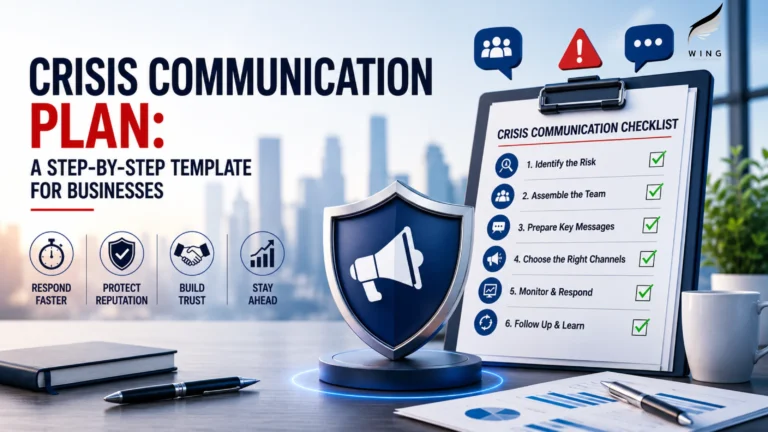
Most companies discover they don’t have a crisis communication plan at the exact moment they need one. A product failure, a leadership controversy, a data breach, a viral customer complaint — and suddenly a founder is drafting a statement under pressure, with legal, PR, and leadership all weighing in at once, often for the first time.
That scramble is avoidable. Here’s a practical framework for building a crisis communication plan before it’s needed — because a plan built during a crisis is really just an improvisation with a template.
Step 1: Define What Counts as a Crisis
Not every negative comment or complaint requires a formal response. A useful first step is categorizing potential issues by severity — a single dissatisfied customer post is different from a safety incident, a regulatory notice, or a leadership controversy. Without this distinction, companies either over-react to minor issues or under-react to serious ones. A simple three-tier framework — monitor, respond, escalate — gives a team a shared reference point instead of case-by-case guessing.
Step 2: Identify the Response Team Before You Need One
A crisis response team typically needs a decision-maker (usually the founder or CEO), a communications lead, legal counsel, and someone monitoring media and social channels in real time. Deciding who holds each role — and who has final sign-off on public statements — after a crisis has already broken is where most delays happen. This should be settled in advance, with contact protocols everyone knows.
Step 3: Build a Holding Statement Template in Advance
The first public response in a crisis rarely needs to have all the answers. What it needs is to acknowledge the situation, confirm the company is looking into it, and commit to a follow-up timeline. A pre-approved holding statement template — adaptable to the specific situation — allows a company to respond within hours rather than days, which matters enormously in how a story develops.
Silence in the first 24 hours is almost always read as evasiveness, even when a company is genuinely still gathering facts.
Step 4: Map Your Communication Channels
Different situations call for different primary channels — a press statement to journalists who are already asking questions, a social media post if the issue originated or spread there, a direct customer communication for service-related issues, or in some cases, a proactive media briefing. Deciding which channel leads, and which follow, prevents a fragmented or contradictory response across platforms.
Step 5: Prepare Leadership for Media Interaction
If a founder or senior executive is likely to be approached directly by journalists during a crisis, they need to be prepared beforehand — not just with talking points, but with an understanding of what not to say. Speculating, assigning blame prematurely, or over-promising a resolution timeline are the most common ways a leader makes a crisis worse in a single interview.
Step 6: Monitor in Real Time
Once a statement is out, the job isn’t done. Tracking how media, social platforms, and — increasingly — AI-generated summaries are representing the situation allows a company to correct misinformation quickly and gauge whether the initial response is landing as intended. A crisis that isn’t monitored closely can shift direction without the company realizing it until much later.
Step 7: Follow Through, Then Follow Up
Once the immediate situation is resolved, the story isn’t fully over. A brief follow-up communication — confirming what was done, what changed, and what was learned — closes the loop credibly and often does more to rebuild trust than the original crisis response did. Companies that go silent after the immediate pressure lifts leave the last public impression as the crisis itself, rather than the resolution.
The Part Most Plans Miss: AI and Long-Tail Visibility
A crisis doesn’t end when the news cycle moves on. Coverage of it remains searchable indefinitely, and increasingly, it becomes part of how AI tools summarize a company when asked about it later — sometimes long after the issue has been resolved. A deliberate, credible follow-up narrative, along with a base of unrelated positive coverage, matters for ensuring a single incident doesn’t define a company’s digital footprint years later.
Building the Plan Before the Fire
The most important thing about a crisis communication plan is that it exists before it’s needed. Companies that build this framework in calm periods — with roles assigned, templates drafted, and monitoring in place — respond faster, more credibly, and with far less internal chaos than those constructing a response in real time.
Wing Communications works with founders and leadership teams to build this kind of preparedness in advance, treating crisis readiness as part of an ongoing reputation and communications practice rather than a service that only gets attention once something has already gone wrong.
FAQs
A crisis communication plan is a structured framework that helps a business respond quickly and consistently to events such as product failures, data breaches, leadership controversies, regulatory issues, or major customer complaints.
A prepared plan reduces confusion and delays during a crisis. It establishes responsibilities, approval processes, communication channels, and response procedures before an unexpected situation occurs.
A strong plan should include crisis categories, a response team, holding statement templates, communication channels, leadership guidelines, monitoring procedures, and post-crisis follow-up processes.
Depending on the organization, the team may include the CEO or founder, communications or PR lead, legal counsel, customer communications representatives, and someone responsible for monitoring media and social channels.
A holding statement is an initial public response issued while a company is still gathering facts. It generally acknowledges the situation, explains that the company is investigating, and provides a timeline for further communication.
Contact WingComm today to schedule a free strategy consultation and discover the right PR mix for your business.