
How to Read a Media Coverage Report Like a Pro
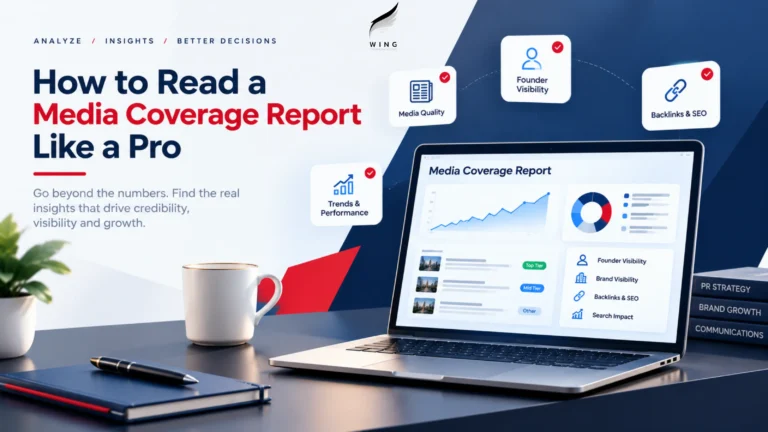
Most founders receive a monthly PR report, skim the article count, and move on. That’s a missed exercise. A well-built coverage report holds more useful information than a headline number — about which stories are actually working, where the gaps are, and whether the PR investment is compounding or plateauing. Reading it properly takes a few extra minutes and a slightly different lens than most founders bring to it.
Start With Tier, Not Volume
The first instinct is usually to look at total placements. Resist that. The more useful first question is: what tier were these placements? A report showing twelve pieces of coverage means very little without knowing how many were genuine editorial features in credible business publications versus wire syndication pickups, which are a different thing entirely — distribution, not independent editorial judgment. A report that blends both categories into a single “coverage” number without distinguishing them is worth questioning.
Check Whether Coverage Is Earned or Placed
Related, but distinct: confirm what’s earned editorial versus what’s paid or sponsored content, if the report includes both. These serve different purposes and shouldn’t be presented as equivalent. A credible agency report should make this distinction clear on its own — if it doesn’t, ask directly. Learn more about media relations and earned press coverage.
Look at the Angle, Not Just the Outlet
A placement in a well-known publication still needs scrutiny on what the story actually says. Was the company or founder positioned as a genuine source of insight, quoted meaningfully within a larger story? Or was the mention a passing reference, technically counted as coverage but contributing little to actual positioning? Outlet prestige alone doesn’t tell the full story — the substance of the piece does.
Track Founder Visibility Separately From Brand Visibility
These are related but distinct workstreams, and a good report separates them. Founder-focused coverage — bylines, quotes, panel mentions — builds a different kind of asset than brand-focused feature stories. A report that only tracks brand mentions may be missing whether founder positioning, often the more durable asset, is actually progressing. Explore leadership PR and founder brand building for more information.
Watch the Trend, Not the Single Month
A single month’s numbers are close to meaningless in isolation. PR compounds — the value of month six’s coverage builds on the credibility established in months one through five. A useful report, reviewed properly, gets compared against the prior quarter, not just read in isolation. A dip in one month against a strong prior quarter is a different story than a dip against a consistently weak trend.
Ask About What Didn't Land
A transparent report should be honest about pitches that went out but didn’t result in coverage — not just what succeeded. This is a genuine signal of effort and story quality, even when it doesn’t show up as a placement. An agency that only reports wins, with no visibility into outreach volume or what was pitched and passed on, makes it hard to judge whether the strategy is sound or just intermittently lucky. Learn more about what a PR agency does and the importance of transparent PR reporting.
Check for Backlink and Search Signal, Not Just Media Mentions
A more sophisticated report increasingly includes what the coverage did beyond the article itself — whether it produced a credible backlink, whether it correlates with branded search increases, whether it’s likely to be picked up by AI tools drawing on published, credible content when someone asks about the company or its category. These downstream signals are becoming as relevant as the placement itself.
Businesses can use Google Search Console to review search impressions and clicks, and follow Google’s SEO Starter Guide to understand search visibility fundam
What a Strong Report Actually Looks Like
The most useful coverage reports don’t just list links. They tier the coverage, separate founder and brand visibility, show trend over time rather than isolated snapshots, disclose what didn’t work alongside what did, and connect coverage to its downstream effects on search and discoverability. A founder who knows to ask for this level of detail gets far more strategic value out of the same reporting relationship than one who just checks the article count each month.
Wing Communications structures its monthly reporting around exactly this level of detail — tiered coverage, founder and brand visibility tracked separately, and downstream backlink and discoverability signal — because a report a founder can actually read and act on is worth more than one that just counts links. Explore Wing Communications and its SEO services to learn more about connecting media coverage with search visibility and long-term brand authority.
FAQs
A media coverage report summarizes a company’s press mentions, editorial features, interviews, founder quotes, and other media placements. A detailed report also evaluates coverage quality, publication relevance, visibility trends, backlinks, and potential business impact.
Start by reviewing publication quality rather than total article count. Then check whether coverage is earned or paid, assess the relevance of each story, compare founder and brand visibility, examine trends over time, and review backlinks and search performance.
Earned media is coverage gained through independent editorial interest, such as interviews, features, and expert quotes. Paid media includes sponsored articles, advertisements, and other placements purchased by a company. Both can support communications goals, but they should be reported separately.
A high number of placements does not necessarily indicate strong PR performance. Coverage in credible, relevant publications can provide more meaningful opportunities to build trust, establish expertise, and reach important stakeholders than numerous low-value or syndicated mentions.
Contact WingComm today to schedule a free strategy consultation and discover the right PR mix for your business.